Field of Science

Professorship in France

On EvolDir there is this job-posting:
*The lab of "Biometry and Evolutionary Biology" UMR CNRS 5558, (***University of ******Lyon**, France)* offers a permanent position for 2013 : Assistant professor (Maître de conférences) in Modelling approach in Genetics-Ecology *

*Teaching :Mathematics**and statistics applied to biology, animal biology*

The applicant will join the teaching staff of the "Agronomy section" of the Biotechnology Departmentof the Technology Institute at Lyon 1 University.He or She will teach mathematical functions and data analysis (1^st year students). The applicant may also be called upon to teach zoology (anatomy and histology of mammals and insects) and genetics (1^st year students). Finally, He or She will participate to the supervision of the numerous tutoring works made by the students of the 2^nd year of the Agronomy section (breeding of animal laboratory models, experimental methodology, reports...) and to the monitoring of the students during their work placement.Beyond teaching, He or She will engage in collective responsibilities of the department and be willing to develop new vocational training.

*Research: Evolution in fluctuating environments: modelling approach in Genetics-Ecology*

Understanding fast evolution of traits (morphological, behaviour, life histories) and population evolvability in fluctuating environments needs on taking into account genetic architecture of these traits in complement to phenotypic approach. The aim is to build models (genetic-ecology) to study how the genetic architecture influences trait evolution. Temporal and spatial components of the environment will be considered. The candidate will be theoretician and modeller with good experiment at the interface between theory, modelling and biological data. He/she will use the data basis (insects and vertebrates) of the evolutionary ecology department in order to build realistic models. He/she will interact greatly with the field ecologists. The candidate must be very familiar with the concepts and modelling/programming tools in evolutionary ecology and, quantitative and population genetic and be able to connect teaching (including animal and vegetal biology) and research activities.


Seriously, what is up with that? The work sounds really interesting, and it sounds like they have really good data. However, this reads like a postdoc position in some professors's lab - not like an assistant professor position! It's a permanent job, and yet they want to dictate this level of detail for someone who is supposed to be an independent researcher. I want to scream that this is not acceptable, but I suppose I should just be glad that things are much more liberal in academia in the United States.

Titles in evolution

Can you spot the odd one out in today's list of titles in evolutionary biology? The category is open, though. For example, the journal Evolution insists on its titles having all-caps, which annoys me like an oyster (but since there are two of those...).

  • Conflictual speciation: species formation via genomic conflict
  • Predictability of evolution depends nonmonotonically on population size
  • Ecological strategies shape the insurance potential of biodiversity
  • Ecological speciation along an elevational gradient in a tropical passerine bird?
  • Mutation rate dynamics in a bacterial population reflect tension between adaptation and genetic load
  • Can a collapse of global civilization be avoided?
  • Long-term culture at elevated atmospheric CO2fails to evoke specific adaptation in seven freshwater phytoplankton species
  • MIGRATION ENHANCES ADAPTATION IN BACTERIOPHAGE POPULATIONS EVOLVING IN ECOLOGICAL SINKS
  • RUNAWAY SEXUAL SELECTION LEADS TO GOOD GENES
  • Evolution of sperm structure and energetics in passerine birds
  • Wormholes record species history in space and time
  • Who Speaks with a Forked Tongue?
  • Evolutionary mode routinely varies among morphological traits within fossil species lineages
  • The effect of spontaneous mutations on competitive ability
  • Adaptive Genetic Variation on the Landscape: Methods and Cases


A general template explaining how different factors influence adaptive genetic variation in the landscape over evolutionary time (Schoville et al., 2013, Adaptive Genetic Variation on the Landscape: Methods and Cases).

Weird comments

I get quite a few anonymous comments to random posts. They are random in that there is no apparent correlation between the content of my posts and their comments.

Examples:

Anonymous has left a new comment on your post "The trouble over inclusive fitness theory and euso...":
I think this is among the most vital info for me. And i am satisfied reading your article. However should remark on some general issues, The website style is perfect, the articles is in reality excellent : D. Good activity, cheers Here is my webpage :: the 2012
Anonymous has left a new comment on your post "Carnival of Evolution statistics":
Thank you for every other informative web site. The place else may just I get that type of info written in such a perfect manner? I have a mission that I'm just now operating on, and I've been on the look out for such information. My blog post ... Movie Maker Forums
Clearly the point is to promote some site (yes, I have changed the links). But why these robotish comment with no relevance to my blog posts?

None of these comments ever get through, because I moderate submitted comments to posts over a week old. And when they do get through to newer posts, they always delete them themselves right away. Why?

I really wish I knew.

Empty talk about the evolution of complexity

PZ Myers has a post on the evolutionary origins of complexity: αEP: Complexity is not usually the product of selection I find it frustrating that people talk about terms that they don't clearly define, and assume everyone agrees on. Especially about complexity, which is hard to define, and I know not everyone has the same idea of. I'll just quote my comment on Pharyngula:
But, you have not quantified complexity, let alone say when there was an increase in it in the hypothetical example you give. If you don’t do this, you can’t talk about the evolution of complexity; it becomes a guessing game what we are talking about, and there is no chance that everyone will think of complexity as the same thing.
On top of that, there seems to be no distinction made anywhere between ‘complexity’ and ‘complex traits’. They need not be the same thing. Without defining complexity here(!), I’ll say that complexity can indeed easily arise by neutral processes, whereas complex traits cannot (but does have neutral and random processes involved) – it requires selection. And with that you’re going to ask me for a definition of a trait, so here is one: A single measurable component of the phenotype that has a function.
The key word here is function, without which I don’t know of any that can evolve without selection. Not selection every step of the way, as random processes are required (at least that’s how it occurs in nature), but selection at some point. The moment the trait acquires function, it becomes selected for.
On the other hand, ‘genomic complexity’ may not describe the state of a trait, but rather is the idea that the genome has many components that are intricately connected – which can arise by neutral processes.

Title in evolution quiz

For those unawares (prolly all), I post these titles in evolution i) as a reminder to myself when I skim the numerous eTOCs that I get in my inbox every week, ii) to point out that evolutionary biology is a very active area of research (while creationism is not), and iii) to share the awesomeness of evolution.

Today it also comes with a quiz.

  • Wormholes record species history in space and time
  • Quasispecies Dynamics of RNA Viruses
  • Genetic background affects epistatic interactions between two beneficial mutations
  • Epistasis between mutations is host-dependent for an RNA virus
  • Evolution of clonal populations approaching a fitness peak
  • Competition and the origins of novelty: experimental evolution of niche-width expansion in a virus
  • Stochastic effects are important in intrahost HIV evolution even when viral loads are high
  • Variable evolutionary routes to host establishment across repeated rabies virus host shifts among bats
  • eplaying the Tape of Life: Quantification of the Predictability of Evolution
  • Phenotypic landscapes: phenological patterns in wild and cultivated barley
  • EVOLUTION OF TRANSCRIPTION NETWORKS IN RESPONSE TO TEMPORAL FLUCTUATIONS
  • Are elder siblings helpers or competitors? Antagonistic fitness effects of sibling interactions in humans
  • Ecological selection as the cause and sexual differentiation as the consequence of species divergence?
  • Adaptation to a new environment allows cooperators to purge cheaters stochastically
  • Fixation of mutators in asexual populations: the role of genetic drift and epistasis Public good dynamics drive evolution of iron acquisition strategies in natural bacterioplankton populations

Guess which of the papers above this figure is from:


54th Carnival of Evolution is up

54th edition is up at ideonexus.com: Carnival of Evolution #54: A Walkabout Mount Improbable.

And it's a super-fancy one, so don't miss it, and let everyone else know, too.


Titles in Evolution overload

There are simply too many interesting papers published in evolutionary biology to keep up with. Not even just reading the abstracts is feasible. Here's a sample of what I find the most interesting from the last couple of weeks:

  • Analyses of pig genomes provide insight into porcine demography and evolution
  • Non-random gene flow: an underappreciated force in evolution and ecology
  • Strengths and weaknesses of experimental evolution
  • Gene duplication as a mechanism of genomic adaptation to a changing environment
  • Revisiting an Old Riddle: What Determines Genetic Diversity Levels within Species?
  • Selection of Penicillin-sensitive Mutants of Escherichia coli following Ultraviolet Irradiation
  • Understanding specialism when the jack of all trades can be the master of all
  • How does adaptation sweep through the genome? Insights from long-term selection experiments
  • Evolutionary layering and the limits to cellular perfection
  • The effects of competition on the strength and softness of selection
  • Crossing the threshold: gene flow, dominance and the critical level of standing genetic variation required for adaptation to novel environments
  • From nature to the laboratory: the impact of founder effects on adaptation
  • Spatially explicit models of divergence and genome hitchhiking
  • Why Transcription Factor Binding Sites Are Ten Nucleotides Long
  • Epistasis as the primary factor in molecular evolution
  • The spatial architecture of protein function and adaptation
  • The effects of stochastic and episodic movement of the optimum on the evolution of the G-matrix and the response of the trait mean to selection
  • TOWARDS A GENERAL THEORY OF GROUP SELECTION
  • PLEIOTROPY IN THE WILD: THE DORMANCY GENE DOG1 EXERTS CASCADING CONTROL ON LIFE-CYCLES

Titles in creationism:

  • Mammalian Ark Kinds
Check it out here: Answers Research Journal. They estimate that there are 137 extant kinds, which means that they must admit to substantial diversification and evolution since the Flood...?

Knowing what I know now...

I'm an evolutionary and computational biologist doing my second postdoc at Michigan State University. I have learned all sorts of thing in this short career, and Jeremy Yoder has asked for advice for a new blog canival.

If I knew then what I know now, I would have...

Focused more on my writing skills very early on. At least as early as my graduate degrees at KGI and UCSB, but perhaps I should really have gotten more into writing during my undergrad in Copenhagen. No one ever told me that being a scientists really amounts to being a writer. I have done nearly nothing but reading and writing for at least six months now, save for giving some talks at meetings and writing 32 lines of code. Write even if you have no data and no conclusions. Write your thoughts down on what you read, what you do in lab, and then it will be easier to write the thesis and papers when it really counts.

Read more. As a scientist, reading is treading water. If you stop, you drown. It's a never ending game, and it is the only way to keep abreast with what is going on. Going to talks is fine, but simply not enough. You must read constantly, or you will be left behind. Often it just means reading abstracts, sometimes also looking over figures (and reading captions) - not that I count, but I count reading abstract and figures as having read a paper. Sign up for eToCs from the major journals in your field. I recommend: Nature, Science, PNAS, Proc. R. Soc. B, Genetics, Evolution, Journal of Evolutionary Biology, The American Naturalist, Journal of Theoretical Biology, Frontiers in Evolutionary and Population Genetics,  PLoS Biology, PLoS Comp Bio. After my first year in grad school, I read the advice from a senior scientist that one should spend the entire first year of grad school mostly reading. I did read a lot, but wish I had read more.

Stopped taking myself so seriously. Actually, I haven't done that in years, but I do think this is invaluable advice. It's just science, after all. If I am wrong about the prevalence of epistasis in adaptation, nobody is going to care. No bridge will collapse and no one is going to die of a misdiagnosis. Keep that in mind, and enjoy yourself. Unless you're an engineer or an M.D, in which case you should stop reading this blog and get back to fukcing work already, or I'll sue your ass off!


Crocodilian relatives that walked upright?

I seriously have trouble believing this. Can anybody shed some light?


It's from the Royal Ontario Museum in Toronto. Wikipedia on Crurotarsans (spelling?) says nothing of it.

Pleiotropy saves the day for evolving new genes

ResearchBlogging.orgWhat is the origin of new genes? In order to do new stuff, new genes are needed. Where do they come from, then?

Horizontal gene transfer (HGT) - direct transfer of a gene from one organism to another - is rampant within bacteria, so they may gain new function this way. However, that does not explain how the gene came to be in the first place.

Neofunctionalization: If the function is carried out by the original, the copy is free to evolve a new function by point mutations (etc.). However, such copies are much more likely to degrade by those mutations and lose the original function, thereby becoming a pseudogene.

Subfunctionalization: If the gene is pleiotropic, i.e. it has more than one function (expressed in more than one trait or cell-type or at different times), then the gene and its new copy can turn off gene expression differentially such that they share the set of functions. However this doesn't allow either much chance for evolving new function by mutation.

So what to do?

Näsvall et al. gave me this present for my 40th: Real-Time Evolution of New Genes by Innovation, Amplification, and Divergence.

They describe a new model/mechanism by which duplicated genes can retain the selection pressure to not succumb to deleterious mutations. They call it the innovation-amplification-divergene model (IAD).

IAD works like this: A gene initially has one function only (A). Then some genetic changes makes it also have a new function, b, which at first is not of too great importance. Then some environmental change favors the gene variants with the minor b-function (the innovation stage). This is then followed by duplication of the gene, such that there are now more than one copy that carries out A and b (the amplification stage). At this stage there is selection for more b, and at some point genetic changes in one of the copies results in a gene that is better at the new function, B. At this point, selection for the genes that do both A and b is relaxed, because the new gene (blue) carries out the new function. The original gene then loses the b function, and we are left with two distinct genes. Viola!

In other words, the green gene first becomes pleiotropic, is copied, followed by divergence, and then loss of pleiotropy. (How they could fail to mention pleiotropy in the article is beyond me.) The crucial feature is that at no point is the gene or any of the copes under no selection; there is always selection for them to be retained, so gene loss never occurs (pseudogenes are not created).

The researchers then look at a preexisting parental gene in Salmonella enterica that has low levels of two distinct activities that allows them to grow without the amino acids histidine and tryptophan, respectively.


Multiple evolutionary trajectories recovered through IAD. The x-axis indicates the HisA activity (assayed as growth rate in minimal glycerol medium with added tryptophan); the y axis indicates the TrpF activity (assayed as growth rate in minimal glycerol medium with added histidine). (A) Evolution of specialist enzymes (yellow) in which one activity is improved at the expense of the other. (B) Evolution of specialist enzymes (yellow) after initial evolution of a generalist enzyme (blue).

The figures here show how the generalist gene evolved to become specialists genes with increased function, doing better without both amino acids.

This is a model that explains how a gene with two functions can evolve to become two genes with distinct function under continued selection. It is this last part about selection that makes it novel, but it relies on the idea that the original gene had already evolved two distinct functions - that it was pleiotropic.
Pleiotropy comes from the Greek πλείων pleion, meaning "more", and τρέπειν trepein, meaning "to turn, to convert". It designates the occurrence of a single gene affecting multiple traits, and is a hugely important concept in evolutionary biology.
Reference:
Näsvall J, Sun L, Roth JR, and Andersson DI (2012). Real-time evolution of new genes by innovation, amplification, and divergence. Science (New York, N.Y.), 338 (6105), 384-7 PMID: 23087246

Carnival of Evolution statistics

David Morrison just hosted Carnival f Evolution #52, and now he has written a post with lots of statistics of CoE: The network history of the Carnival of Evolution.

In short, we're doing quite well compared to many other carnivals who have gone extinct. This is especially true for science carnivals, of which CoE is the only active carnival listed on BlogCarnival.com.


The steady growth of CoE through time. "Fortunately, the number of posts has shown a steady upward curve, as indicated in the sixth graph, although not always at the one-blog-post-per-day rate set in the earliest days. However, over the past 20 Carnivals there has been an average of 1.06 blog posts cited per day of passing time, so we are certainly holding our own."

Titles in evolution - and in creation?


Here we go again with the new articles on evolution. This is just a very small sample that I chose out of interest from the last couple of weeks - and just from a few journals that I get eToCs sent from. In the meantime there has been nothing in Answers Research Journal, and I don't know where else to check. If you do, please let me know.

  • Variation in personality and fitness in wild female baboons
  • Biodiversity tracks temperature over time
  • Epistasis as the primary factor in molecular evolution
  • Aposematism and the Handicap Principle
  • Turning Back the Clock: Slowing the Pace of Prehistory 
  • Physico-Genetic Determinants in the Evolution of Development 
  • The spatial architecture of protein function and adaptation
  • Complex brain and optic lobes in an early Cambrian arthropod
  • Crossing the threshold: gene flow, dominance and the critical level of standing genetic variation required for adaptation to novel environments
  • Mutational meltdown in selfing Arabidopsis lyrata
  • Aging: An Evolutionarily Derived Condition
  • What could arsenic bacteria teach us about life?
  • Genomic Variation in Natural Populations of Drosophila melanogaster
  • Clonal Interference in the Evolution of Influenza
  • Evolutionary Dynamics on Protein Bi-stability Landscapes can Potentially Resolve Adaptive Conflicts
  • Criticality Is an Emergent Property of Genetic Networks that Exhibit Evolvability


Ochman on bacterial evolution

ResearchBlogging.orgYesterday I went to the annual Thomas S Whittam Memorial Lecture here at MSU. Howard Ochman talked about "Evolutionary Forces Affecting Bacterial Genomes", though he had changed the title to "Determinants of Genome Size and complexity.

Based on research in his lab had two conclusions about the evolution of bacterial genomes:

  • Genome size is drifting
  • GC-content is under selection
The very tight correlation between gene content and genome size (i.e., there is a linear relationship between number of genes and length of the genome) is driven by genetic drift, and not selection. People often say that small genomes are selected for, but clearly there are not. This is in part caused by a bias towards deletions (compared to insertions). I asked him why there is this bias, and he did not have an answer. (Well, he gave me an answer, but he also acknowledged that it didn't get to the point.) The common ancestor had a large genome, and many bacteria - particularly pathogens and endosymbionts - have subsequently lost DNA resulting in a reduced genome size (Kuo et al, 2009, but see Kuo and Ochman, 2010).


There are trends in the GC-content (amount of guanine and cytosize in the DNA) that differs among bacterial taxa. But closely related species have similar GC-content, and it turns out that genetic drift is not responsible for this, but that it is driven by selection. "Escherichia coli strains harboring G+C-rich versions of genes display higher growth rates" (Raghavan, 2012).

Genome size and abundance of pseudogenes correlates with the size of the effective population size: a larger Ne gives larger genomes, while smaller Ne results in smaller genomes. Pseudogene abundance is less straightforward, with the largest and smallest genomes and Ne both having few pseudogenes, but those intermediate in size having many.


References
Kuo CH, & Ochman H (2010). The extinction dynamics of bacterial pseudogenes. PLoS genetics, 6 (8) PMID: 20700439
Kuo CH, Moran NA, & Ochman H (2009). The consequences of genetic drift for bacterial genome complexity. Genome research, 19 (8), 1450-4 PMID: 19502381
Raghavan R, Kelkar YD, & Ochman H (2012). A selective force favoring increased G+C content in bacterial genes. Proceedings of the National Academy of Sciences of the United States of America, 109 (36), 14504-7 PMID: 22908296

Genotype-phenotype maps and mathy biology

ResearchBlogging.orgI'm reading a book chapter by Peter Stadler from 2002 called Landscapes and Effective Fitness [1]. It has this absolutely gorgeous figure:


 I love it. But just before this figure he has this equation:

I hate it. I hate it because all it says is that each type, x, is at a frequency Px of the total population, so those Px sum to one. But of course. I just don't think this kind of writing is conducive to discourse, because in biology there is already a huge gap between the majority who don't read (and cite) papers with equations, and those who write them. So why muddy the waters with equations like this that says next to nothing?

However, I reiterate (and is why I'm reading the chapter) that this figure of a genotype-phenotype-fitness map is super cool.There are many more different genotypes (the genetic make-up of an organism) than there are different phenotypes (the combined physical attributes of the organism). This must be so, because we now know that each trait is affected by many genes; it takes more than one gene to make a trait (there may be exceptions where only one gene encodes a trait).

The figure is a conceptual map, but real g-p mapping is sort of the holy grail in evolutionary biology at the moment. With a real map like in hand evolutionary dynamics can be predicted, and we will be able to say which genetic changes are required to change the phenotype. However, realistically we can only map a very small portion of the genotype on to the phenotype, and there even seems to be some confusion about what the proper answer is to the question of what the genotype-phenotype map looks like. Hopefully the answer won't be too mathy...

References
[1] Peter F. Stadler, & Christopher R. Stephens (2003). Landscapes and Effective Fitness Comm. Theor. Biol DOI: 10.1080/08948550302439
[20] A testable genotype-phenotype map: Modeling evolution of RNA molecules. In: Lässig, M. and Valleriani, A., editors, Biological Evolution and Statistical Physics, pp. 56–83. Springer-Verlag, Berlin, 2002.

How to be a good speaker

Bjørn's two rules of being a good speaker:
  1. Love the words that you speak
  2. Always have something to say
An engaged speaker is more enjoyable to listen to than a bored one. If you love the words as they leave your mouth, you are more likely to engage the audience. Caveat: we all hate someone who loves to speak - too much. I am here talking about giving a presentation, where you are expected to deliver a monologue. In dialogue, be a good listener.

If you don't have something to say, don't give a talk. As a scientist, this is the same as not having done anything, in which case you are not doing your job. But I also mean this in a more general sense: live life learning, and have your lessons to share. If not, then it's a waste, in my opinion.

I'm at the 16th Evolutionary Biology Meeting in Marseille, and I trust I don't need to say that some of the presentations don't measure up to the science behind them. And that's a shame; people being bored listening to your talk when they really should be excited about the science. It's a total myth that all one needs to do is do good science, and people will be interested in your talk. Rather, unless it is the something you are supremely interested in (which is probably only a small fraction of what you hear at conferences and seminars), then people tend to lose interest, tune out, and sometimes even feel antipathy for the speaker.

There are other things a speaker can do, but those are not my rules.

I am speaking tomorrow evening on the Impact of Epistasis and Pleiotropy on Adaptation.

Epistasis in evolution

[The following is a post written for BEACON.]

What is epistasis?
Epistasis is a measure of the strength of epistatic interactions. Epistatic interactions are non-additive interactions between alleles, loci, or mutations. That is, if the combined effect of a pair of mutations is not what we expect from their individual effects, we then say there is epistasis between those two mutations.

Two mutations that are both detrimental on their own can be beneficial when they occur together. An example of this is from Joe Thornton’s lab: the present function of reduced sensitivity to hormone in vertebrate glucocorticoid receptor is an example of this. Two mutations both reduced sensitivity and destabilized the newly duplicated gene shortly after its birth 450 million years ago. A third mutation – neutral without the first two mutations – buffered the destabilization, and allowed to gene to go fixation (Carroll et al., 2010).

Epistasis is mostly measured in terms of fitness, as the deviation from additivity, but in principle any trait-value can be used*. If mutation A increases fitness by 5% and B increases fitness by 10%, then we might expect that an organism with both mutations get a fitness increase of 1.05×1.10=1.155 or 15.5%. This would be the case if the two mutations do not interact, so that their effects on fitness are independent of each other. The deviation can be measured in various ways, but the proper way of doing it would be like this:

ε = log10[WAB × W0/ (WA × WB)],

where W0 is the fitness of the organisms with neither mutation. This is the best definition (!), because we assumed above that the effects of the mutations are to increase fitness by a fraction of the current fitness, rather than by adding a number. If mutations did increase fitness by an absolute number, we might measure epistasis as

ε = WAB + W0 – (WA + WB).

Both of these measures are then zero when there is no epistasis, and both can be extended to deal with more than two mutations interacting. When ε>0 we call it positive epistasis, and negative epistasis when ε<0 (Fig. 1).

So, if an organism with both mutations have a fitness of 1.20, then the amount of epistasis is ε = log10[1.20 / (1.05 × 1.10)] = 0.01660. If two deleterious mutations together have a beneficial effect, the sign of the joint effect is reversed, and this is called reciprocal sign epistasis (e.g., WA = 0.95, WB = 0.90, WAB = 1.20, giving ε = 0.1472). A trivial case of negative epistasis is when both mutations are independently neutral, but their joint effect is deleterious (e.g., WA = 1.0, WB = 1.0, WAB = 0.90, ε = -0.04576). I say this is a trivial case, because this type of interaction could be one where two genes carry out the same function, thereby exhibiting robustness by being redundant; the organisms then only suffers a fitness decrease when both genes are not working properly.
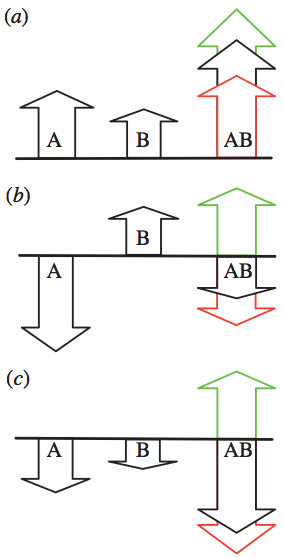
Fig. 1: Schematic illustration of epistasis. Two mutations A and B can interact epistatically in different ways with varying effects on fitness. The fitness of the wild-type is represented by the black baselines, and the heights of arrows represent the fitness after one mutation (WA or WB) and after both mutations (WAB). Green, positive epistasis, red, negative epistasis, black, no epistasis. In (a), two independently beneficial mutations may have their joint effect increased or diminished (WAB larger or smaller), while in (b) the independent effect of the two mutations is deleterious and beneficial, respectively, and the combined expected effect on fitness is deleterious. In (c), each mutation by itself is deleterious, but when they interact, the result can be reciprocal sign epistasis (green arrow). These sketches illustrate an additive model, where the sum of WA and WB is equal to WAB without epistasis. In our model, using the geometric mean this corresponds to taking the logarithms of the fitness. From Østman et al. (2012).

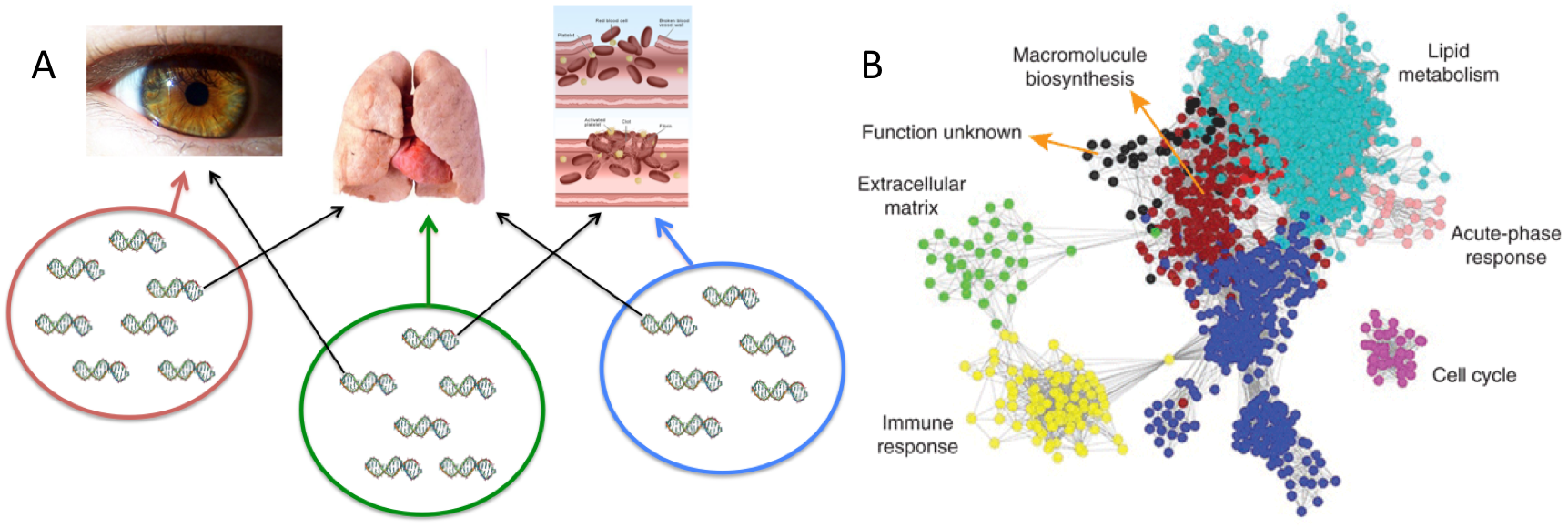
Epistasis is a feature of the genotype-phenotype map, and of genetic architecture. The genes that together are responsible for a trait (e.g., eyes, lungs, blood-clotting) are likely to interact and have non-zero epistasis. Many genes are also pleiotropic, i.e. part of gene-networks of more than one trait (Fig. 2), as they are expressed in different contexts (tissues, cell-types, in response to different environmental cues, etc.).
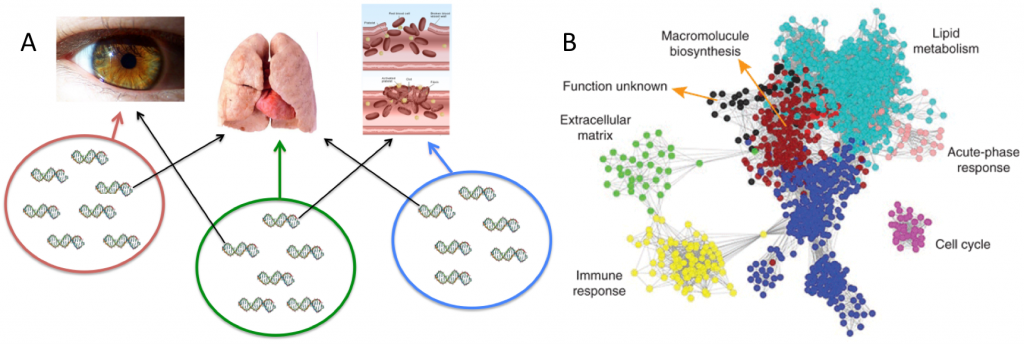
Fig 2: Epistatic modules. (A) Hypothetical genotype-phenotype map with three modules of groups of genes affecting three traits: eyes, lungs, and blood-clotting. The genes within each module interact epistatically, while some genes exhibit pleiotropy (black arrows). Not all pairs of genes affecting the same trait necessarily have a non-zero epistasis. (B) Human liver coexpression network and corresponding gene modules. The gene coexpression network consists of the top 12.5% most differentially expressed genes (5,012 expression traits). The colors of the nodes represent their module assignments. Each of the colors correspond to a trait, and most genes are only expressed in that trait, though some are expressed in more than one (pleiotropy), as indicated by lines signifying coexpression. From Friend (2010).

Why is epistasis important in evolution?
One reason why epistasis is so important in evolutionary biology is that it affects the fitness landscape. The structure of the fitness landscape in large part determines many important things in evolution, such as evolvability, robustness, repeatability, contingency, and speciation. If the environment dictates that on set of genes/loci has a particular combination of alleles that optimizes fitness, then without epistasis each gene can be optimized individually until the optimal combination is reached (i.e., there is one peak in the local fitness landscape, aka smooth landscape). Deterministically, the population will end up on the peak. However, if the genes/loci interact, then fitness values are modified, and the fitness landscape will no longer be smooth, but contain multiple local peaks with valleys in between. Evolution in such a rugged fitness landscape will not be predictable, and multiple outcomes are now possible. Because there are multiple peaks the population might get stuck on a local peak with lower fitness than the highest peak in the landscape. Another possibility is that more than one peak is climbed at the same time, and if such a situation can be sustained, it can lead to evolutionary branching and even speciation.

Another reason why epistasis is so important is that interactions between genes means that much more complex traits can be made. If genes did not interact, then no trait would be affected by more than one gene (is this necessarily always true?). It is of course not possible to make a complex structure with only one kind of protein. Conversely, the more genes interact within a module, the more complex the trait can be, which in turn translates into higher fitness. With only a handful of genes available, only a simple eye can develop, while many genes together can make a more complex structure, which can increase the organism’s fitness. The fact that genes interact epistatically is why complex multicellular organisms with abundant cellular differentiation are possible at all.

How prevalent is epistasis?
Very. Basically, when people measure it, pretty much all pairs of mutations are epistatic. That’s hard to believe is true, and it probably isn’t. Measuring fitness is generally difficult; you have to measure the fitness of four organisms, and just a little bit of error will give ε different from zero. Therefore it is reasonable to attribute lots of non-zero measures below some limit to no epistasis. And then still, it turns out lots of pairs of mutations have significant epistasis between them.

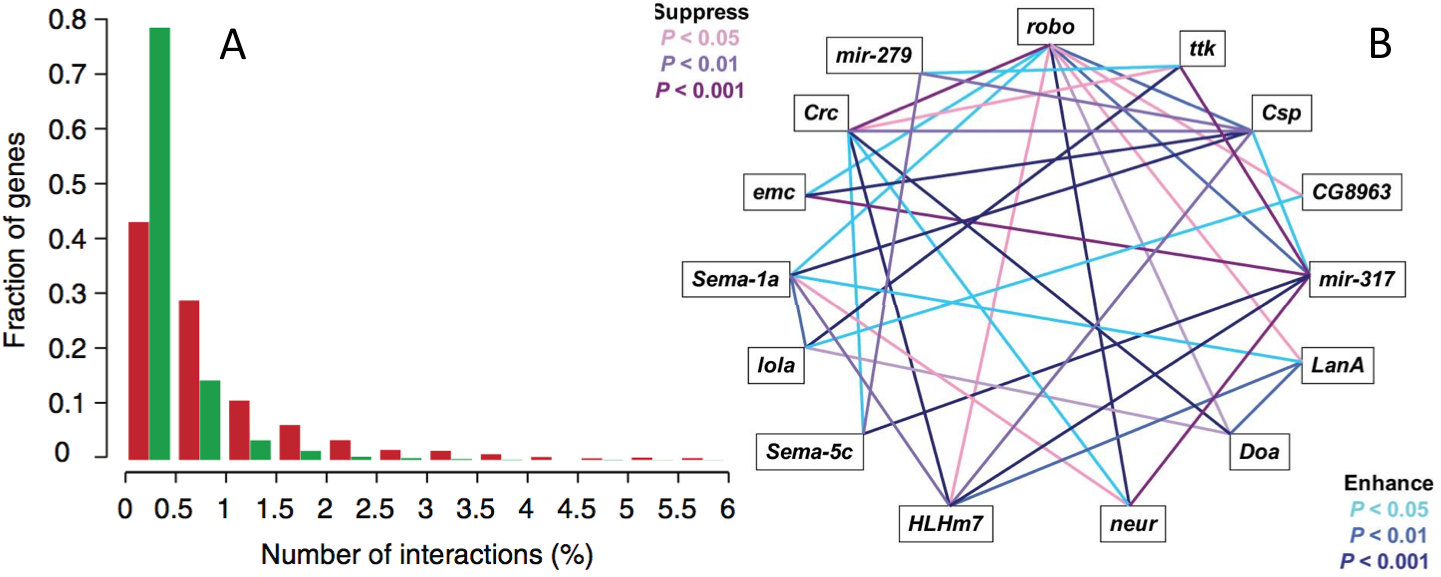
For example, Costanzo et al. (2010), using data from a genome-wide, quantitative analysis of genetic interactions in yeast, showed that even when including only high values of epistasis (|ε|>0.08), then a large fraction of gene pairs are epistatic (Fig. 3A). Or in Drosophila melanogaster, where 15 insertions in the genes involved in startle-induced locomotion show extensive genetic interactions (Fig. 3B)
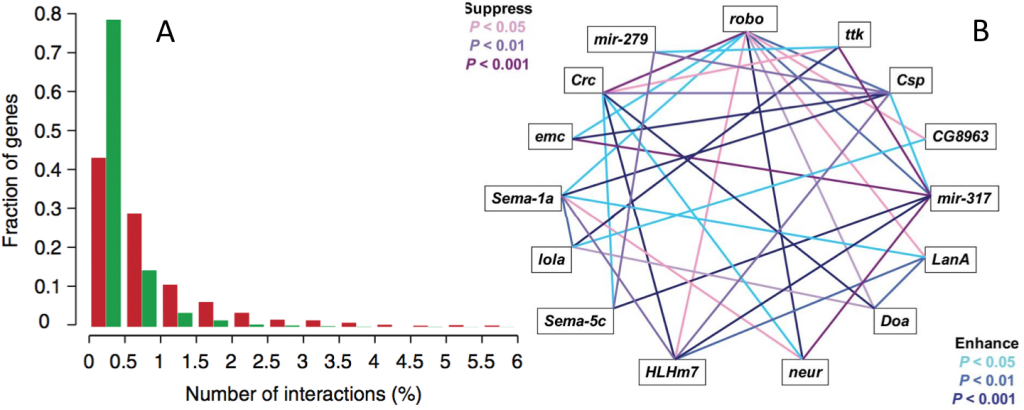

Fig. 3: Prevalance of epistasis. (A) The distribution of genetic interaction network degree for negative (red) and positive (green) interactions involving query genes. From Costanzo et al. (2010). (B) Epistatic interactions for startle-induced locomotion among 15 P[GT1] insertion lines in double heterozygous genotypes. From Yamamoto et al. (2008).

What is the current research focus?
Two major areas of research in evolution are adaptation and speciation. This has been so for a long time, and while we do know a lot about both, there is little doubt that this will not change in the foreseeable future. Adaptation is particularly affected by epistasis and pleiotropy, and it is an outstanding question to what extent adaptation is enhanced or mitigated by epistasis. Empirical data suggest that epistasis causes diminishing returns (e.g., Kahn et al, 2010), but this probably just means that the shape of fitness peaks are shallower the closer you get to the apex, which would just mean that the biggest returns on fitness comes with the first beneficial mutations (which are more likely to go to fixation in the first place). How much does epistasis affect evolvability? Fitness landscape ruggedness can limit a population’s ability to evolve, and ruggedness depends on the amount of epistasis among and within genes. But are these epistatic interactions set in stone, or are they malleable? In other words, how easy is it to create epistatic interactions, and once formed, can they be broken and allow for new advances in adaptation?

Speciation is also a much studied area of evolutionary biology, but the impact of genetic architecture is only recently coming into focus. Epistasis can cause Dobzhansky-Muller incompatibilities, which can lead to reproductive isolation (which is cool if your gold standard of speciation is the Biological Species Concept). But more generally, the epistastic nature of the genetic architecture causing multiple fitness peaks implies that evolutionary branching can occur. It remains an open question how much this is governed by epistasis, and particularly whether epistasis is a prerequisite for speciation of microbes.

* Not that I am thereby saying that fitness is just another trait. I hold the view that fitness – reproductive success – is a function of other traits, such that a network would point from genes to traits, and traits to fitness.

References
Carroll SM, Ortlund EA, and Thornton JW (2011). Mechanisms for the evolution of a derived function in the ancestral glucocorticoid receptor. PLoS Genetics, 7 (6) PMID: 21698144
Costanzo M, et al. (2010). The Genetic Landscape of a Cell Science, 327 DOI: 10.1126/science.1180823
Friend SH (2010). The need for precompetitive integrative bionetwork disease model building. Clinical pharmacology and therapeutics, 87 (5), 536-9 PMID: 20407459
Khan AI, Dinh DM, Schneider D, Lenski RE, and Cooper TF (2011). Negative epistasis between beneficial mutations in an evolving bacterial population. Science (New York, N.Y.), 332 (6034), 1193-6 PMID: 21636772
Yamamoto A, Zwarts L, Callaerts P, Norga K, Mackay TF, and Anholt RR (2008). Neurogenetic networks for startle-induced locomotion in Drosophila melanogaster. Proceedings of the National Academy of Sciences of the United States of America, 105 (34), 12393-8 PMID: 18713854
Østman B, Hintze A, and Adami C (2012). Impact of epistasis and pleiotropy on evolutionary adaptation. Proceedings of The Royal Society Biological sciences, 279 (1727), 247-56 PMID: 21697174

What would surprise you?

How often do you go "shiiiiiiiiiiit, so that's how it is!?!" What would really shock you? "FUCK! I never thought that would be the case..."

Probably not that often. But those moments are so great, and as a scientist, I'd say we sort of live for them.

I was thinking about this in terms of working in evolution. What would be a really big moment that I could say advanced my understanding of how living things evolve? Most papers I read anymore are incremental advances. Actually, all of them are. When I first started learning about evolution, I was in near-constant shock/revelational mode. It was pure delight to discover what we know about evolution. But now that I know most of it, nothing much surprises me anymore. Which is a shame.

So it got me thinking about where I could search for such moments. Something akin to learning that the Earth is not the center of the universe, or that everything is made of atoms. Or that there were dinosaurs, and that we evolved. The rest seems to be details. Important details, but not revelational.

I do various things in evolution, but my overarching focus is the origin of evolutionary novelty (but I like speciation, too). How do new things come into existence? The first eyes, first brain, first blood. People will then say that those things are derived from previous structures. Eyes from simpler photoreceptors, brains from simple nervous systems, blood cells from other cells. And these systems derived from yet simpler cells, but along the way, something new happened at least at some points that enabled these new systems/structures to form. New proteins were added to the mix, encoded by new genes. So where did these new genes come from? Well, they were derived from other genes, by duplication and neofunctionalization: a new gene is a copy and a refashioning of an old gene. So far so good. Then where did the first gene come from? Sorry, I don't work on origin-of-life stuff.

Is that it? Not quite. There are some major transitions in evolution to be explained. Unicellularity to multicellularity, cellular differentiation, asexual to sexual reproduction, and stuff like that.

But then, I am still left with this feeling at times that there is really nothing that would really upset my world-view (of evolution) much anymore. Still nothing revelational in sight. I hope I'm wrong.

Titles in evolutionary biology

These are the new papers for the last couple of weeks that I would like to read but will probably never get to. Gone are the days of the polymaths already, and now this!

  • Systematic underestimation of the age of selected alleles
  • Predatory Fish Select for Coordinated Collective Motion in Virtual Prey
  • Rapid evolution of Wolbachia incompatibility types
  • Avoidance of roads and selection for recent cutovers by threatened caribou: fitness-rewarding or maladaptive behaviour?
  • Weak Selection and Protein Evolution
  • Patterns of Neutral Diversity Under General Models of Selective Sweeps
  • Selective Sweeps in Multilocus Models of Quantitative Traits
  • Distinct evolutionary patterns of morphometric sperm traits in passerine birds
  • A selective force favoring increased G+C content in bacterial genes
  • Evolutionary Dynamics of Strategic Behavior in a Collective-Risk Dilemma
  • Evolution of Stress Response in the Face of Unreliable Environmental Signals
  • Network Context and Selection in the Evolution to Enzyme Specificity
  • Clade Age and Species Richness Are Decoupled Across the Eukaryotic Tree of Life
  • Evolutionary medicine: its scope, interest and potential*
  • The role of ‘soaking’ in spiteful toxin production in Pseudomonas aeruginosa
  • On the evolutionary origins of the egalitarian syndrome
  • Clade Age and Species Richness Are Decoupled Across the Eukaryotic Tree of Life

* Because I am meeting with Stephen Stearns when he visits MSU this Thursday, I will take an actual look at this review article. Paul Ewald was here last week, and we had a good talk about selection in pathogens and human disease. I also met with Randolph Nesse last semester, so evolutionary medicine has been in focus a lot lately.

ENCODE: What defines genomic function?

ResearchBlogging.orgA new wealth of articles by the ENCODE (the ENCyclopedia Of DNA Elements) consortium suggest that far more of the human genome carries out some function or other, and one might conclude that very little DNA is junk:

From an introduction to the new ENCODE papers:
Collectively, the papers describe 1,640 data sets generated across 147 different cell types. Among the many important results there is one that stands out above them all: more than 80% of the human genome's components have now been assigned at least one biochemical function.
[Emphasis added.]
80%? That is a lot (see [2] for details). It doesn't throw out the idea of junk-DNA, i.e., that there is DNA that has no function - but it puts the number much closer to zero than the 90% that I have heard before. But I seriously wonder what is meant by "function". Take a look at this image[1]:


 Gene regulation is a very spatial thing, which means that if you were to move a gene (i.e., the protein-coding DNA, or exons) somewhere else, then if would probably not be transcribed at the right time. So, if you were to cut out a length of DNA that doesn't have any function, then other DNA will be shifted spatially, and this might screw up proper transcription. So, DNA without function might be important as a filler. On the other hand, ENCODE includes in the 80% everything that is transcribed (i.e., DNA is used to produce RNA), but that doesn't mean that it has a function, as defined in my book. RNA may be floating around in the cell, and may never be translated (into protein), and may not have any other (e.g. regulatory) function either. On top of that, ever if it is translated and a protein is created based on that DNA, it doesn't necessarily follow that the protein does anything (could even be detrimental to the organism), and then that surely isn't functional.

To me, this is one of those moments where my understanding of how things work is challenged. If it really is true that no more than 20% of the human genome is junk (and it apparently could be a lot less than that), then I am happy to update my understanding, but I am super-skeptical that there is that little junk in the human genome. But I am not too happy with the usage of the words junk and non-functional here.

References
[1] Joseph R. Ecker, Wendy A. Bickmore, Inês Barroso, Jonathan K. Pritchard, Yoav Gilad & Eran Segal (2012). Genomics: ENCODE explained Nature, 489 DOI: 10.1038/489052a
[2] The ENCODE Project Consortium (2012). An integrated encyclopedia of DNA elements in the human genome Nature, 489 DOI: 10.1038/nature11247