Field of Science

Creationist implosion


Since the middle of last week I have been having an email conversation with a creationist. He emailed me after we had a conversation several years ago, now asking various questions about evolution, including stuff that really isn't evolution, but cosmology, geology, and chemistry. I replied that I don't really want to talk about things that I am not an expert in, to which he agreed. Following that the conversation narrowed to something I do know more than a bit about, and out of courtesy I asked if he would be okay with me posting the conversation to my blog. His reply was this:

"As long as you post my responses in their entirety, and give me opportunity to respond to your post, that would be fine."

So I proceeded because I am a nice guy/dumb ass who apparently can't resist getting sucked into time-sinks, but at least with the idea in my mind that I would share with a few readers. Let it at the very least serve as a reminder to myself not to waste my time talking about evolution with creationists - it really leads nowhere. I believe that more and more people will be less dogmatic, but mainly because young people have access to better information, and are therefore less likely to get sucked into the vortex of creationism.

Below I list a few of the email exchanges. Some emails in between are not listed, but these emails are shown in their entirety. My answers in smaller font follow his emails. I have highlighted all that was said about posting to my blog in red.

On November 6, 2013 at 10:17 AM [redacted] wrote: 
Hi Bjorn,
When you say: “ some are deleterious, and the least will be beneficial with respect to fitness,” that is a bit confusing.  You say mutations do not cause a net loss of genetic information over evolutionary time, but then say some mutations are deleterious.  It sounds like you are saying both are true.  The confusing part is saying the least will be beneficial, as though that would always be the case.  My understanding is from what I have read that would rarely be the case, and the randomness of mutational change would not always project that way.
Yes, I realize that this is the crucial point where I have not been able to convey the situation adequately.
In any one individual, when they are egg is fertilized/cell duplicates, there are going to be a number of mutations. On average (but not for all), most will have no effect on fitness (neutrals), some will decrease fitness (deleterious), and even fewer will increase fitness (beneficials). However, within the population, there is going to be a lot of variation. Some individuals will carry many deleterious mutations, but some (fewer) will carry enough beneficial mutations that the overall effect of all the mutations they carry is to increase fitness. Those are the ones that are (with luck) selected and become the ancestors of future generations.

About genetic information: Information is always with respect to something. In evolution it is with respect to the environment. If the fitness has increased, then we say that the information content has increased. Crucially, this can be done by any of the known kinds of mutations that I mentioned in an earlier email: insertions, deletions, inversions, point mutations, transposons, duplications (tandem, whole genome), recombination, crossover, and more. All of these kinds of mutations can potentially be either neutral, deleterious, or beneficial. Genetic information does emphatically not equate to the amount of DNA in the genome; lots of the genome is junk and serves no function currently, though it may have in the past, and it may again in the future.
Concerning deletions though, if the protein is 100 amino acids long, and mutational deletions occur so now it is 98 amino acids long, but because of a rearrangement of genetic sequence it ends up being a beneficial change to fit in with its current environment, an increase in fitness takes place which is passed on.  Am I correct so far?  But if other deletions take place over evolutionary time that eventually shortens the gene sequence to 80 amino acids long, is that not still a net loss of genetic information over evolutionary time?  Am I using the right terms?
See above about genetic information. If the deletion of 18 amino acids is deleterious (decreases fitness and thus the information about the environment), then it will be selected against, and individuals with such a mutation will not likely have any ancestors. If it is actually beneficial to get rid of 20 amino acids, then the change is beneficial. And that is all that matters. Strictly speaking, talking about loss of information is not something evolutionary biologists do very much. The key term is fitness. The crux is whether the mutational changes cause the individuals to have more or less offspring that the rest of the individuals in the population.
You also say: “some individuals in the population will by chance have a net increase in fitness.” Here again we are looking to the occurrence of a beneficial mutation which is said to be extremely rare, and sometimes it seems at the expense of a net loss of information.  Should we always look for or expect the best case scenario, which it seems this would be doing?  I know I’m asking a lot of questions but it has to logically make sense to me before I can accept it.  Thanks again for your patience.
I'm not sure what you mean by best case scenario. Selection of course "looks for" the fittest individual, so to speak.

As explained above, for one individual there is no net loss of information if there is a net increase in fitness. The genome may be reduced in size, but that is really neither here nor there. 

I'm not sure what you mean by best case scenario. Selection of course "looks for" the fittest individual, so to speak.
Bjørn

P.S. I hope that the above clarifies some things, and because I think it does, I'd like to post everything above to my blog, with your permission?

On November 6, 2013 at 5:16 PM [redacted] wrote: 
Hi Bjorn,
So then do you believe there is any accuracy to the following statements at all? 
“Mutations are very rare.  They occur only once in every ten million replications. 
Mutation rates vary a lot. It is not clear what "replications" refer to here, but in humans, for example, there are no children born without some mutations compared to their parents. It is estimated to be ~1.1×10⁻⁸ per site per generation, which means that there are an average of about 1.1×10−8  x 3×109 = 30 mutations per generation. It can be much higher in some other organisms.
The chance of two related mutations occurring is one in 100 trillion; given the abundance of genes in living organisms, however, mutations can and do occur. 
I'm not sure what you mean by 'related'. If you mean identical, then that would indeed be a very small number, like one in 3 billion (which is the length of the human genome - and here I am assuming they are point mutations, aka SNPs = single nucleotide polymorphisms).
Even so, most mutations are harmful, leading to death of the organism before birth or a loss of a specific function. 
No, most mutations have no effect at all (neutrals). Most of the human genome is DNA that has no function, and there it doesn't matter if you change one nucleotide. Even in the protein-coding sequences, you can change many nucleotides without effect (the genetic code is redundant). And even if a mutation actually changes an amino acid, it need not matter for the protein. And even if it does matter for the protein, it may not matter for fitness. Even among deleterious mutations, many have only slight effects, and are not lethal (to the organisms or to the traits they affect). Lethal mutations are rare compared, but of course the effect is easy to spot. We all carry genomes with at least minor deleterious effects, but as long as they are minor, we can live with them.
Only one in 1000 are not harmful and most of those are neutral, having no effect on the organism. 
No, again, most, most mutations are neutral. Fewer are deleterious. I am not sure where you get the 1 in 1000 number from. Also, which fraction is neutral/deleterious/beneficial varies over time, between environments, and between organisms.
Certainly this is why mutations are to be avoided.  Mutagenic radiation and chemicals should be avoided, not embraced.”
I agree that for the individual human being, it is best to avoid mutations. No biologists would ever say that it would be good for humans to expose themselves to anything that increases the number of mutations. But mutations are nevertheless the stuff that increases variation, which is what selection acts on.

Bjørn
On November 6, 2013 at 5:54 PM [redacted] wrote: 
Hi Bjorn,
This still isn’t making any sense.  I don’t think you should post yet.  The DNA code is a set of instructions.  If deletions occur that cause a loss of function, as is sometimes the case, how then is it not a loss of information, and not just a loss of fitness?  Talking about a loss of information might not be something that biologists talk about much as you have said, but that doesn’t mean it doesn’t happen.  You made the statement that it doesn’t happen.
If we are to talk more about information, then please first tell me why we can't just talk about what really matters, namely function and fitness. The crux of the matters, I hope you will agree, is how evolution can make new things. Evolution can, as has been shown, by rearranging DNA in all sorts of ways (the different kinds of mutations as described earlier), applied to both protein coding sequences (which code for proteins) and to regulatory sequences (the DNA that controls gene expression = the turning on and off of the genes that make proteins).
No, I said it doesn't happen very much. In fact, my professor is an expert in applying information theory to evolution (his name is Chris Adami). I also note your reluctance to say what this information is about - talking about information doesn't make sense without stating this. Some code may have information in some context, but not in another.
I do agree with you now about the total amount of DNA not being important.  I just read that duplication of a single chromosome is normally harmful, as in Down’s syndrome, and that Insertions often completely destroy the functionality of existing genes.  A loss of function to me means loss of information, even when something is added through duplication or insertion.  So I would agree the total amount of DNA would not be important but whether or not it provides or takes away function, which would again go back to loss of instruction or information, which is really somewhat different than fitness.
Yes, function is different than fitness. However, it is fitness that determines what happens in evolution. If loss of function increases fitness, then loss of function may happen. As in the case of blind cave-fish, which loss vision after living in dark caves for many generations. It was hypothesized that mutations that caused their eyes to stop functioning was beneficial because eyes are generally a liability (to infections, for example). But whether it was beneficial or not to lose the eyes, they lost them because there was no light in the caves anyway.
You also seem to be saying every time an egg is fertilized there will be several mutations.  If the Biology textbooks are accurate, then mutations are rare, plus the enzymes that repair copying errors factor in.  Look at this statement from www.nature.com : “Mutations can have a range of effects. They can often be harmful.  Others have little or no detrimental effect.  And sometimes, although very rarely, the change in DNA sequence may even turn out to be beneficial to the organism.”  Emphasis on “very rarely.”
Actually, to be precise the mutations happen not when the egg is fertilized, but when then egg and sperm are created. Yes, mutations are indeed rare, in part because of the error-correcting machinery.

I read the article by Joel Carlin. I promise you that he did not mean to say that there are generally more deleterious than neutral mutations. And yes, it is even rarer that mutaions are beneficial. But sometimes they are, and that is enough.
Can you give me any examples of beneficial mutations in humans other than sickle cell anemia?
That is a great example, though, isn't it? Another is the gene that enabled humans to metabolize lactose, and thereby drink milk. Very beneficial

Other examples just found by searching: 

From http://sciphi.wikkii.com/wiki/List_of_Beneficial_Mutations_in_Humans"

"Some people carry a mutant allele of the CCR5 gene that results in lack of expression of this protein on the surface of T-cells. Homozygous individuals are resistant to HIV infection and AIDS."

"Atherosclerosis is principally a disease of the modern age, one produced by modern diets and modern life-styles. There is a community in Italy near Milan whose residents don't get atherosclerosis because of a fortunate mutation in one of their forebearers."

"In humans, two cone cell pigment genes are located on the sex X chromosome, the classical type 2 opsin genes OPN1MW and OPN1MW2. It has been suggested that as women have two different X chromosomes in their cells, some of them could be carrying some variant cone cell pigments, thereby being born as full tetrachromats and having four different simultaneously functioning kinds of cone cells, each type with a specific pattern of responsiveness to different wave lengths of light in the range of the visible spectrum. One study suggested that 2–3% of the world's women might have the kind of fourth cone that lies between the standard red and green cones, giving, theoretically, a significant increase in color differentiation. Another study suggests that as many as 50% of women and 8% of men may have four photopigments."

Note that it is not always obvious that these mutations actually increase fitness (i.e., the amount of children people have), but even if they are neutral mutations, they certainly changed function.

Read this blog-post: http://bigthink.com/daylight-atheism/evolution-is-still-happening-beneficial-mutations-in-humans

"Most random genetic changes are neutral, and some are harmful, but a few turn out to be positive improvements. "
"People with the Apo-AIM gene have significantly lower levels of risk than the general population for heart attack and stroke, and pharmaceutical companies are looking into marketing an artificial version of the protein as a cardioprotective drug."

"Mutations which impair the function of LRP5 are known to cause osteoporosis. But a different kind of mutation can amplify its function, causing one of the most unusual human mutations known."
I found this interesting also.  Have you heard about this?  I just read this this afternoon.  It was once believed that flies resistant to DDT were mutants.  However, it was found that a certain population had the genetic material to make them resistant to DDT all along.  Gotta go.
Next time please supply links to these things.


On November 7, 2013 at 3:53 PM [redacted] wrote: 
Question: Do mutations cause a net loss of genetic information over evolutionary time?                            Answer: "Yes", lost protein function can be said to be loss of information with respect to that function, and  "No", mutations do not cause a loss of function over time.  Thanks for clearing that up for me.  Mutations cause lost protein function and do not cause a loss of protein function, as long as they don't reproduce.  Hypothetically, if it produces a fitness and is passed on, or it can just still survive, and the next generation loses more protein function, but not enough to become extinct, has information been lost in regards to that protein function? 
But that doesn't happen. Some/most individuals in the population will not have deleterious mutations, so those with deleterious mutations will mostly be selected against. Hypothetically yes it could be as you said if the mutational load is really large, but it isn't.
Every time a beneficial mutation survives because of fitness, it still loses genetic information in regards to protein function. 
No! If an individual has a beneficial mutation, there is no loss of genetic information with regard to protein function. There is in fact an improvement of protein function and thus an increase in genetic information.
Fitness will eventually lose out in all beneficial mutations because of loss of protein function.  Your theory is on a downward path in spite of all your optimism, and that will never produce an increase in complexity over time.  Look around you.  Life forms are going extinct, not new life forms coming into existence.  That is what is observed.
The theory is fine, and I observe adaptation happening in digital systems and in laboratory experiments, despite your perceived problems with it. You asked me what I was afraid of and this is it. That I spend all this time trying to explain how evolution works, and then you end up not getting it anyway. :( I'm going to post exactly what I want, now.

I do look around me, and while we are in the middle of a mass extinction event where more species are going extinct than new species appear, new species do nonetheless appear by speciation (that is not to say I am at all optimistic about the current mass extinction, which is a sad and horrible affair). Speciation takes many generations to complete, so it is not something we can easily observe in nature. But sometimes we can, like in the case of Podarcis sicula, a lizard in croatia, with stickleback fish, fruit flies, house mice, and in many plants, just to name a few off the top of my head.
On November 7, 2013 at 9:46 PM [redacted] wrote:
Hi Bjorn,
You do understand if you post what you want now you are not only doing so without my permission, I specifically told you you couldn't.  You might want to rethink that.

On November 7, 2013 at 9:48 PM [redacted] wrote:
Hi Bjorn,
After all the forced mutations of fruit flies, aren't the ones then ended up with less fit for just about any environment, and the last I checked they are still fruit flies.
Omg, this is just a creationist talking point!!! "Fruit flies" are not one species - there are many species of fruit flies. 

Yes, I will post some of our conversations on my blog. If you want to talk more, the comments there will be the place to do it. Please do not waste my time by emailing me again.
On November 7, 2013 at 11:16 PM [redacted] wrote:
Since you refuse to heed my request to not post our conversations, you leave me no alternative but to take another course of action regarding this matter.
EOF. 

So now I look forward to finding out what "another course of action" will be...

Here's one of those memes that I keep seeing on Facebook. I add it here for no other reason than I like to have an image in every post I write. It bears absolutely no relation to the topic of this post.


Creationists are infuriating - but not as much as we are

I haven't blogged much lately because of other things in life. Shame. Things like work and applying for a Green Card. This has taken me out of the loop of dealing with creationists for a while, too, but a couple of days ago an old online acquaintance emailed me in reply to a post from five (5!) years ago.

Just reading these helplessly clueless long emails about why evolution allegedly can't work (e.g., because there are more deleterious mutations than beneficials!!!), let alone answering them, leaves me frustrated and exhausted this time around. Not only is is frustrating that there are people out there that stubborn in their ignorance, but it is also that evolution is what I do for a living. Science is my passion, and evolutionary biology is the field I am in. So it kind of hurts when someone says that a topic I have studied intensely for 10 years is completely wrong about nature - I am either a liar or very stupid.

A few years ago, before I got my PhD, I debated online with creationists on a regular basis. I had fun with it, and found it enlightening to learn about this strange group of people. It felt good to tell them when they said something wrong and to inform them how they had misunderstood evolutionary theory (always benevolently assuming that was the true cause of disagreement). But now it is just irritating. Why this change?

The change in me from glee to despair has two causes:

1) It is now annoying to talk to creationists because the naîve childish hope that they would change is gone. I still have hope that future generations will see the light, so to speak, and not be so bogged down by their religious dogma and resistance against their world-view-from-a-book. But people who have invested their life in religious dogma are a lost cause, and it therefore makes no sense for me to have a personal dialogue with them anymore.

2) The second reason why I now get so upset is that I had forgotten a tenet that I came up with years ago: Evolutionary biologists may be exasperated with creationists, but probably not nearly as much as creationists are constantly provoked by evolutionary biologists. After all, close to but not quite a 100% of all biologists understand that evolution is the best explanation for how life on Earth has come about (save for abiogenesis, if you will) and how species continue to change.


The science is getting funded and published and winning hearts and minds. Creationism isn't getting any traction. America is a special case, with most other countries laughing their cabooses to shreds. (Next to) nobody studies life through the lens of creationism at educational and research institutions. On top of that, evolutionary theory is actually being applied in medicine, engineering, and other fields, while prayer generally isn't implemented in hospitals and R&D departments.

62nd Carnival of Evolution

The 62nd edition: The Whig History is up at Joachim Dagg's Ecology and Evolution Footnotes. It's a voluminous and excellent edition, but as Joachim notes, getting enough submissions is more and more becoming the chore of the host.

More at Carnival of Evolution...

Repo Men and gender roles

Scene 1:

Man comes home to find that his key doesn't work anymore. He rings the bell, his wife opens the door, and tells him hers works just fine. She has had the lock changed. She gives him his suitcase, which she has packed for him. She tells him she is taking their child to her mother's. Man leaves with suitcase.

Scene 2:

Woman comes home to find that her key doesn't work anymore. She rings the bell, her husband opens the door, and tells her his works just fine. He has had the lock changed. He gives her her suitcase, which he has packed for her. He tells her he is taking their child to his father's. Woman leaves with suitcase.


Scene 1 is from Repo Men. It's a fairly common scene from TV and the movies. These are stories we tell each other, because these are events that really take place somewhere every day. Repo Men is a story about organ transplants in the future - it is not social realism about the relationship between married men and women with children.

Scene 2 is not seen often. I don't recall seeing such a scene in a movie or on TV, but it could be out there somewhere. Here's my prediction, though: If scene 2 does exist, it is in a story about the relationship between married men and women with children. And why am I fairly confident in this prediction?

The makers of Repo Men wanted me to be outraged that a company takes back artificial organs that people hadn't met their payments on, but it was scene 1 that really pissed me off. It is women who are underpaid and biased against in the job-market. I hate that. I want to get to the truth of that, and fix it, and I am not alone. Politicians talk about it, because their constituents talk about it, because it is fair that gender alone shouldn't result in two equally qualified people in the same job earning different salaries. But no one talks about scene 2. 

Scene 1 happens on a daily basis because it is the norm that mothers are the primary care-givers, and that somehow gives them more rights to the children. The law (in the places I know about) explicitly says that father and mother have the same legal rights to their children, and yet this is not how things are enforced. If the police is called for a domestic dispute, their initial assumption - which they act upon - is that the husband is the problem. Courts rule in favor of women more than men in disputes over child custody. And men allow this as well, because we feel deeply that mothers are more important to children than fathers are.

Scene 1 is sad, but it seems reasonable to us.

Scene 2 is weird, because that would be fucked up. Right?


Carnival of Evolution the 60th edition up at NeuroDojo


The 60th edition is now up at NeuroDojo. Go check it out, it doesn't have very many posts (what is going on with that, btw? Summer?), but Zen wrote a great one.


I'm just a little disappointed he didn't make a new logo. Something like this?

(I have no idea wtf I am doing.)

We need someone to host the July edition. And August. We love the volunteers.

See you in Snowbird?

My pet theory about the human nose: breastfeeding

Why is the outer nose shaped as it is? Why don't humans just have two holes in the face, rather than this protuberance that we care so much to have the right shape of?

Here's the best illustration I've seen of my pet hypothesis:


Imagine that little baby had two holes rather than a nose. It would suffocate. That huge breast would block the air intake, making it impossible to breastfeed. But when the baby's nose is pushed from the front, slits are formed that enable the baby to still breathe through the nose.

In other words, humans have a proboscis so that they can breastfeed.

Some support: Cows, dogs, and cats have a slit to the side, making them able to breathe when their noses are blocked form the front.


A caveat: Snub-nosed monkeys have no external nose, but just two holes. Admittedly, they probably breastfeed. I wonder how they do it. They also sit with their faces downwards when it rains, to prevent rain from entering their nostrils. I wonder if the olfactory abilities of these monkeys are reduced?


More on the variation of nose shapes in humans and the evolutionary origin of the human nose, but nowhere can I find anyone suggesting a link between nose-shape and breastfeeding.

Carnival of Evolution #59 is up

The 59th edition of Carnival of Evolution is now up at DNA Barcoding.

Letter from the Doctor.

CoE needs hosts for the next editions, and you could host the 60th one! It's a thoroughly rewarding experience, and your blog will get lots of exposure. Plus, it's really very little work. Interested?


P.S. 

Knock, knock.
Who's there?
Doctor.
Doctor who?

or 

Knock knock.
Who's there?
How the hell did you know?

Can we predict evolution?

ResearchBlogging.orgEvolution is not predictable, right? It has famously been said that if we were to rerun the tape of life, it would be very unlikely that something like humans would evolve again. I could add that, surely, on other planets suitable for life it would be highly unlikely that organisms looking identical to us would evolve. However, I personally would not be totally surprised if there were intelligent bipedal quadrupeds on other planets somewhere, but this is very little beyond pure speculation (I could talk about it at length - but that is not the same as writing about it).

One of the problems with predicting evolutionary outcomes is that the number of influencing factors is huge. Physics is a field of science where predictions can be very accurate - just think of sending rovers to Mars: the precision needed for that to succeed is daunting, and is a testament to the success of physics. However, this success stems from the simplicity of the physical systems that people have studied. Newton studied objects falling, which is a pretty simple thing with few factors influencing the outcome. The only relevant factor involved is gravitation, and it was fairly easy to achieve good predictability. The factors influencing the rover on its way to Mars are actually quite few as well. Biologists have a much harder time because the systems the first studied were so much more complex. Living things are just that much more complicated than a dead object falling (even if it is a living apple).

Evolution is driven by random changes to the genome and environmental factors. That's it. The problem is just that those are both highly unpredictable, whereas in physics things are easier. But here is the point I want to make: It's only easier in physics because physicists elect to study systems that are simple. There is a great joke where a physicist is able to predict the winner of any horse race to multiple decimal points - provided it was a perfectly elastic spherical horse moving through a vacuum (Wikipedia). Physicists don't contend with studying what is actually there in its messy reality, but instead reduce the problem to one that can be solved. Even though heating a pot of water involves many individual particles, boiling can be predicted with high accuracy, but only if it assumed that a meteor isn't going to crash the kitchen! Externalities are ignored and assumed not to happen. And that works well for physics, because that assumption is safe in many systems. But it is not safe at all in evolution.

The number of external effects that drive evolution is immense. But trying to predict evolution by starting with a model that includes everything is never going to work. First we must understand the simplest cases - in an approach identical to the one that has made physics so successful. We have to do this even if there is no system that actually evolves in this sort of vacuum in nature. Once we understand that system, we can build on it by adding more layers of complexity. Perhaps then one day mainstream biologists will be happy...

Population Size
The core entity of evolution is the population. It is the population that evolves, not the species or the individual. And the first thing to know about a population is its size, N. The size is the main determinant of what will happen to new mutations, such as the probability of fixation (i.e., the mutation existing in all individuals) and the strength of selection (governing whether a mutation will be under the influence of selection, or just genetic drift - note that there is always drift, which comes from the stochasticity (randomness) that is inherent in the evolutionary process, but sometimes it matters little compared to selection, which completely dominates in the case of an infinitely large population).

Mutation Rate
The second parameter to know is the rate at which new mutations appear, the mutation rate, µ. If there are no mutations (no more realistic in nature than an infinitely large population size), then evolution comes to a halt when genetic drift or natural selection has eliminated all variation. If µ is very large, the the population will experience a mutational meltdown and the loss fitness due to the accumulation of harmful mutations. The product of the population size and mutation rate is called the mutation-supply rate, µN. This quantity determines how many mutations occur: if it's low, then there are few mutations. In much of evolutionary theory it is assumed that the mutation-supply rate is so low that each mutation appears and goes to fixation (or most likely is lost) before the next mutation appears. This makes mathematics much easier, but it is not a realistic assumption. Rather, pretty much all natural populations have a mutation-supple rate large enough that there is always many different mutations present in the population. This is true for humans and for bacteria - and especially for viruses.

Lots of advances have been made in evolutionary theory (population genetics) given only these two parameters. But there is another that makes a huge difference, which describes what effect mutations have.

Fitness Landscape
The fitness landscape is a map where fitness is given as a function of the genotype or the phenotype. In other words, this function describes the expected reproductive success of every type of organisms in the population. If the fitness landscape is known, then the effect of every mutation is known, and it can be predicted statistically how the population will evolve. If the landscape is smooth (see Fig. 1) then there is only one outcome possible: the population will ascend the peak and then stay there. But if the landscape is rugged, then the population risks getting stuck on a local peak (at least for a very long time), or it may be fortuitous enough that it finds the global peak.

Figure 1. Smooth and rugged one-dimensional fitness landscapes. Both are simply fitness given as a function of either genotype or phenotype. Smooth landscapes have a single peak and the dynamics on it is very predictable: for non-zero mutations rates, the top of the peak will be located sooner or later. The only exception is if the mutation rate is very high, in which case all offspring have deleterious mutations that take them off the peak, aka as a mutational meltdown. The rugged landscape have multiple peaks separate by valleys of lower fitness. In the NK landscape rugged landscapes also have a greater range in fitness than smooth landscapes. This is an effect of pleiotropy, which in NK is coupled to the K-parameter, which determines the amount of genetic interaction. P.S. Not sure why I didn't indicate the axes here. Amateur! Again, it's fitness on the vertical axis, and genotype or phenotype on the horizontal axis. I could add, though, that a picture like this is more consistent with fitness as a function of a continuous phenotype (e.g., body size), while functions of genotype will most often be discrete. From Østman and Adami (2013).

Evolutionary dynamics in rugged landscapes are much harder to predict. That goes for the endpoint of evolution (the genotype or phenotype that the population ends at), which is easy to predict in smooth landscapes, and it is also true for the path that is taken. In one dimension the path is not hard to predict (if the population start to the left in the smooth landscape in Fig. 1, then it will move to the right until it hits the peak), but if there are many paths, then the situation is not so simple. If we look at the fitness landscape in Fig. 2A, which is reconstructed from Khan et al (2011), we see that there are many paths that can lead from genotype 00000 to 11111. Note that in this figure fitness is given for each of the 32 genotypes, but are plotted as a function of how many mutations away they are from the (arbitrarily chosen) 00000 genotype.

A population that starts at 00000 will end up on 11111, but it can take a number of routes there. Because the fitness gains are highest going through 00010 first, and then through 00110, 10110, 11110 to 11111, that route is most likely, but because evolution is a stochastic process (mutations are random and high fitness makes it more likely that you get to reproduce, but not certain), other routes are possible. In this example, Khan et al. actually found that the path taken was via 01000.

Figure 2. Two fitness graphs where fitness are given by the genotype. The genotype consists of five loci - each of which can take the value of 0 or 1 - and the horizontal axis therefore cannot contain that information. Instead the axis shows the number of mutations each genotype is away from an arbitrarily chosen "wild-type". An edge indicates a one-mutant connection between genotypes.  (A) Taken from Khan et al. (2011), evolution in this landscape is easy to predict. With a population starting at 00000, genotype 11111 will eventually be located. There are no other peaks than 11111 that the population can get stuck on. Which path will actually be taken is a different matter: even though it is most likely the population will go to 00010 first, and then 00110, 10110, and 11110 to 11111, the actual path taken was different, going through 00001. (B) This instance of an NK fitness landscape is rugged, with three distinct peaks at 11110, 11101, and 00000. Starting a population at 11111 it cannot be said with certainty where the population will end up. Most likely the population will go though one or both of the local peaks at 11110 and 11101. If the mutation-supply rate is low there won't be enough mutations available for the population to cross the valley going through genotypes 10101 or 01001. However, for higher mutation-supply rates (which can be achieved both by increasing the population size and the mutation rate) the higher number of mutations will ensure that the valley is eventually crossed (without having to wait for eons), and the global peak is reached.


We can of course discuss the relevance of different paths. Does it really matter which path is taken? Where the population ends up seems more relevant, but suppose the population is a virus that we are fighting with anti-virals. In that case, we'd like to kill all the viruses, but if they evolve resistance, we could perhaps combat them with targeted drugs if we know which path they were going to take. 

Figure 2B shows a rugged landscape with several peaks (at 11110, 11101, and 00000). If the population starts at 11111, it is most likely to go through 11110 and/or 11101. However, if the supply of mutations is low (WM, weak-mutaiton regime), the population risks getting permanently stuck there, and thus not able to locate the global optimum at 00000. By "permanently" I mean that the population will sit there for a very long time. Eventually it will move up, but it can take longer than other events that can change the landscape, and, if the fitness of those suboptimal genotypes are too low, the population can go extinct before they are able to escape to higher fitness. Fitness also affects population size, so that a population sitting on 11110 would in this case be about 10% lower than if it were sitting on 00000. In the simulation shown in Vid. 1 the population size is fixed at N=1,000, so this effect does therefore not occur. The mutation rate is very high, so the population is able to escape 11101 and 11110 by crossing the valley to reach 00000.


Video 1. Evolution in a rugged landscape. A population of 1,000 individuals evolving on a fitness graph all starting at genotype 11111. Mutation rate is 0.1 per generation (= chance to have one mutation; no double-mutations allowed here). The simulation is a Moran process (one individual is replaced by the offspring of another every update). The area of the circles are proportional to the number of individuals at that genotype.


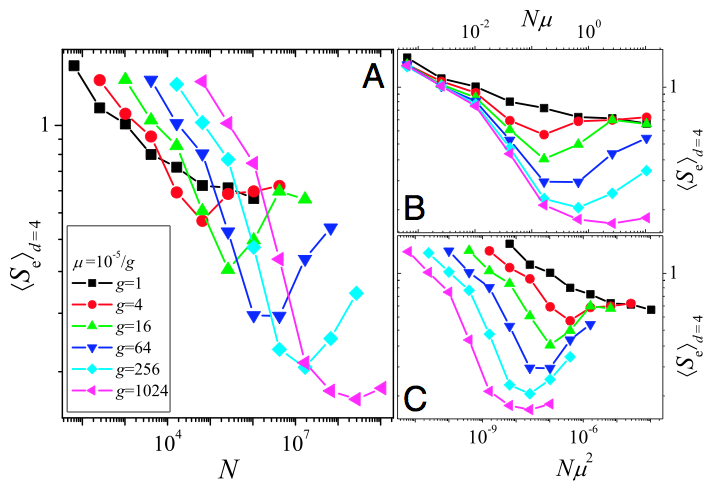
One way to quantify how predictable evolution is is using information theory.  The Shannon entropy was used by Szendro et al. (2013) to quantify how predictable evolution is in simulations of evolution in the Aspergillus niger fitness landscape (Fig. 3). One simply counts the frequency, pi,  of each endpoint in a large number of replicate simulations (here, 100), and calculates the entropy as 

.

The lower the entropy S is, the higher predictability is. When all states are the same, pi=1, and S=0.
Figure 3. Predictability of endpoints of evolutionary paths measured using entropy. When the entropy is  low, predictability is high. Entropy is basically a measure for how uniform the results are: if all endpoints are the same, then entropy is zero. The different colors are for different mutation rates (black highest). Predictability is given as a function of population size (A), mutation-supply rate (B), and rate of double-mutants (C). The finding is that predictability is not monotonic, that is, at very high population sizes predictability goes down again (entropy increases). d=4 indicates the Hamming distance from the global optimum, which is easier to find the more mutations there are, which is why predictability is higher for larger N. Szendro et al. (2013) explains this decrease in predictability as "a consequence of increased appearance of double mutants", by which they might mean that the number of mutations is so high that the mutational load (decrease in average fitness due to deleterious mutations) makes finding the global optimum harder.

Evolution in smooth landscapes is very predictable (in terms of endpoints), while rugged landscapes can decrease predictability because the population can get stuck on different fitness peaks (which doesn't mean that a rugged landscape can cause speciation - for that, other factors are needed, like reproductive incompatibilities between different genotypes or negative frequency-dependent selection). Just as is seen in Fig. 3, increasing the mutation rate (up to a point) in rugged NK landscapes increases the chance that the population will find the global peak (Østman et al,, 2012).

Yes, we can predict evolution, but to achieve high predictability, certain conditions have to be met. A large mutation-supply rate helps, as does low ruggedness of the fitness landscape. So too does static landscapes; if the fitness landscape changes on time-scales comparable to the population dynamics, then predictability will suffer. There is very little research done on such dynamic fitness landscapes and how they affect evolutionary dynamics. One obvious question to tackle before answering this question is just how the landscape changes over time. Not much is known about this in natural populations, but it could be studied computational for different classes of changes, like peaks suddenly disappearing vs. more subtle changes in fitness values.

In summary, evolution is predictable if we know population size, mutation rate, and the fitness landscape.

References
Khan A, Dinh D, Schneider D, Lenski R, and Cooper T (2011). Negative Epistasis Between Beneficial Mutations in an Evolving Bacterial Population Science, 332 (6034), 1193-1196 DOI: 10.1126/science.1203801

Szendro IG, Franke J, de Visser JA, and Krug J (2013). Predictability of evolution depends nonmonotonically on population size. Proceedings of the National Academy of Sciences of the United States of America, 110 (2), 571-6 PMID: 23267075

Østman B and Adami C (2013). Predicting evolution and visualizing high-dimensional fitness landscapes in "Recent Advances in the Theory and Application of Fitness Landscapes" (A. Engelbrecht and H. Richter, eds.). Springer Series in Emergence, Complexity, and Computation (to appear). arXiv: 1302.2906v2

Østman B, Hintze A, and Adami C (2012). Impact of epistasis and pleiotropy on evolutionary adaptation. Proceedings. Biological sciences / The Royal Society, 279 (1727), 247-56 PMID: 21697174

The war on science™

According to Science Left Behind (book review), there's a war on science, and it isn't raged by conservatives alone. Progressives are also ideologues who refuse to listen to the science - it's just other areas that they dislike.

Conservatives:
  • Climate change (science: it is happening, and is caused by humans)
  • Evolution (science: it is true)

Progressives:
  • Homeopathy (science: it doesn't work)
  • Vaccines (science: they work and are do not cause autism)
  • GMOs (science: they are not harmful)
  • Organic foods (science: they are not always better)
  • In vitro meat (science: it is fine, and better in so many ways)
  • Biological gender differences (science: there are some)

Anything else?

My guide to better talks

I like public speaking, and would like to be better at it. Two rules I have been living by are:
  1. Love the words that you speak
  2. Always have something to say
Number 2 is a general rule, as it means that you should have done something, thought about something, and have formed an opinion that you can speak about.

All very well, until the day I saw myself on video giving a talk that I had not practiced, thinking I'd be fine and convey the points I wanted to. I did convey those points, but was also horrified at some things that I did. I made some observations, and here is the list to remedy those deficiencies:
  1. Stand up straight (I have bad posture)
  2. Speak clearly (no mumbling)
  3. Finish sentences (no trailing sentences)
  4. Speak precisely (say only what you need to say)
  5. Shave and get a hair-cut (don't look like a bum)
  6. Be modest (don't be smug)
  7. Arms down (or think about your gesturing, at least)
3 to 9 apply to me, and are not general rules. I do think different styles of speaking can allow for breaking each of these, but in general they are good to follow. Either way, I really need to work on them.

Here's Hans Rosling, my favorite speaker.


Professorship in France

On EvolDir there is this job-posting:
*The lab of "Biometry and Evolutionary Biology" UMR CNRS 5558, (***University of ******Lyon**, France)* offers a permanent position for 2013 : Assistant professor (Maître de conférences) in Modelling approach in Genetics-Ecology *

*Teaching :Mathematics**and statistics applied to biology, animal biology*

The applicant will join the teaching staff of the "Agronomy section" of the Biotechnology Departmentof the Technology Institute at Lyon 1 University.He or She will teach mathematical functions and data analysis (1^st year students). The applicant may also be called upon to teach zoology (anatomy and histology of mammals and insects) and genetics (1^st year students). Finally, He or She will participate to the supervision of the numerous tutoring works made by the students of the 2^nd year of the Agronomy section (breeding of animal laboratory models, experimental methodology, reports...) and to the monitoring of the students during their work placement.Beyond teaching, He or She will engage in collective responsibilities of the department and be willing to develop new vocational training.

*Research: Evolution in fluctuating environments: modelling approach in Genetics-Ecology*

Understanding fast evolution of traits (morphological, behaviour, life histories) and population evolvability in fluctuating environments needs on taking into account genetic architecture of these traits in complement to phenotypic approach. The aim is to build models (genetic-ecology) to study how the genetic architecture influences trait evolution. Temporal and spatial components of the environment will be considered. The candidate will be theoretician and modeller with good experiment at the interface between theory, modelling and biological data. He/she will use the data basis (insects and vertebrates) of the evolutionary ecology department in order to build realistic models. He/she will interact greatly with the field ecologists. The candidate must be very familiar with the concepts and modelling/programming tools in evolutionary ecology and, quantitative and population genetic and be able to connect teaching (including animal and vegetal biology) and research activities.


Seriously, what is up with that? The work sounds really interesting, and it sounds like they have really good data. However, this reads like a postdoc position in some professors's lab - not like an assistant professor position! It's a permanent job, and yet they want to dictate this level of detail for someone who is supposed to be an independent researcher. I want to scream that this is not acceptable, but I suppose I should just be glad that things are much more liberal in academia in the United States.

Titles in evolution

Can you spot the odd one out in today's list of titles in evolutionary biology? The category is open, though. For example, the journal Evolution insists on its titles having all-caps, which annoys me like an oyster (but since there are two of those...).

  • Conflictual speciation: species formation via genomic conflict
  • Predictability of evolution depends nonmonotonically on population size
  • Ecological strategies shape the insurance potential of biodiversity
  • Ecological speciation along an elevational gradient in a tropical passerine bird?
  • Mutation rate dynamics in a bacterial population reflect tension between adaptation and genetic load
  • Can a collapse of global civilization be avoided?
  • Long-term culture at elevated atmospheric CO2fails to evoke specific adaptation in seven freshwater phytoplankton species
  • MIGRATION ENHANCES ADAPTATION IN BACTERIOPHAGE POPULATIONS EVOLVING IN ECOLOGICAL SINKS
  • RUNAWAY SEXUAL SELECTION LEADS TO GOOD GENES
  • Evolution of sperm structure and energetics in passerine birds
  • Wormholes record species history in space and time
  • Who Speaks with a Forked Tongue?
  • Evolutionary mode routinely varies among morphological traits within fossil species lineages
  • The effect of spontaneous mutations on competitive ability
  • Adaptive Genetic Variation on the Landscape: Methods and Cases


A general template explaining how different factors influence adaptive genetic variation in the landscape over evolutionary time (Schoville et al., 2013, Adaptive Genetic Variation on the Landscape: Methods and Cases).

Weird comments

I get quite a few anonymous comments to random posts. They are random in that there is no apparent correlation between the content of my posts and their comments.

Examples:

Anonymous has left a new comment on your post "The trouble over inclusive fitness theory and euso...":
I think this is among the most vital info for me. And i am satisfied reading your article. However should remark on some general issues, The website style is perfect, the articles is in reality excellent : D. Good activity, cheers Here is my webpage :: the 2012
Anonymous has left a new comment on your post "Carnival of Evolution statistics":
Thank you for every other informative web site. The place else may just I get that type of info written in such a perfect manner? I have a mission that I'm just now operating on, and I've been on the look out for such information. My blog post ... Movie Maker Forums
Clearly the point is to promote some site (yes, I have changed the links). But why these robotish comment with no relevance to my blog posts?

None of these comments ever get through, because I moderate submitted comments to posts over a week old. And when they do get through to newer posts, they always delete them themselves right away. Why?

I really wish I knew.

Empty talk about the evolution of complexity

PZ Myers has a post on the evolutionary origins of complexity: αEP: Complexity is not usually the product of selection I find it frustrating that people talk about terms that they don't clearly define, and assume everyone agrees on. Especially about complexity, which is hard to define, and I know not everyone has the same idea of. I'll just quote my comment on Pharyngula:
But, you have not quantified complexity, let alone say when there was an increase in it in the hypothetical example you give. If you don’t do this, you can’t talk about the evolution of complexity; it becomes a guessing game what we are talking about, and there is no chance that everyone will think of complexity as the same thing.
On top of that, there seems to be no distinction made anywhere between ‘complexity’ and ‘complex traits’. They need not be the same thing. Without defining complexity here(!), I’ll say that complexity can indeed easily arise by neutral processes, whereas complex traits cannot (but does have neutral and random processes involved) – it requires selection. And with that you’re going to ask me for a definition of a trait, so here is one: A single measurable component of the phenotype that has a function.
The key word here is function, without which I don’t know of any that can evolve without selection. Not selection every step of the way, as random processes are required (at least that’s how it occurs in nature), but selection at some point. The moment the trait acquires function, it becomes selected for.
On the other hand, ‘genomic complexity’ may not describe the state of a trait, but rather is the idea that the genome has many components that are intricately connected – which can arise by neutral processes.

Title in evolution quiz

For those unawares (prolly all), I post these titles in evolution i) as a reminder to myself when I skim the numerous eTOCs that I get in my inbox every week, ii) to point out that evolutionary biology is a very active area of research (while creationism is not), and iii) to share the awesomeness of evolution.

Today it also comes with a quiz.

  • Wormholes record species history in space and time
  • Quasispecies Dynamics of RNA Viruses
  • Genetic background affects epistatic interactions between two beneficial mutations
  • Epistasis between mutations is host-dependent for an RNA virus
  • Evolution of clonal populations approaching a fitness peak
  • Competition and the origins of novelty: experimental evolution of niche-width expansion in a virus
  • Stochastic effects are important in intrahost HIV evolution even when viral loads are high
  • Variable evolutionary routes to host establishment across repeated rabies virus host shifts among bats
  • eplaying the Tape of Life: Quantification of the Predictability of Evolution
  • Phenotypic landscapes: phenological patterns in wild and cultivated barley
  • EVOLUTION OF TRANSCRIPTION NETWORKS IN RESPONSE TO TEMPORAL FLUCTUATIONS
  • Are elder siblings helpers or competitors? Antagonistic fitness effects of sibling interactions in humans
  • Ecological selection as the cause and sexual differentiation as the consequence of species divergence?
  • Adaptation to a new environment allows cooperators to purge cheaters stochastically
  • Fixation of mutators in asexual populations: the role of genetic drift and epistasis Public good dynamics drive evolution of iron acquisition strategies in natural bacterioplankton populations

Guess which of the papers above this figure is from:


54th Carnival of Evolution is up

54th edition is up at ideonexus.com: Carnival of Evolution #54: A Walkabout Mount Improbable.

And it's a super-fancy one, so don't miss it, and let everyone else know, too.