


noun
- a large cage, building, or enclosure for keeping bears in.


 Please help me with a little science experiment.
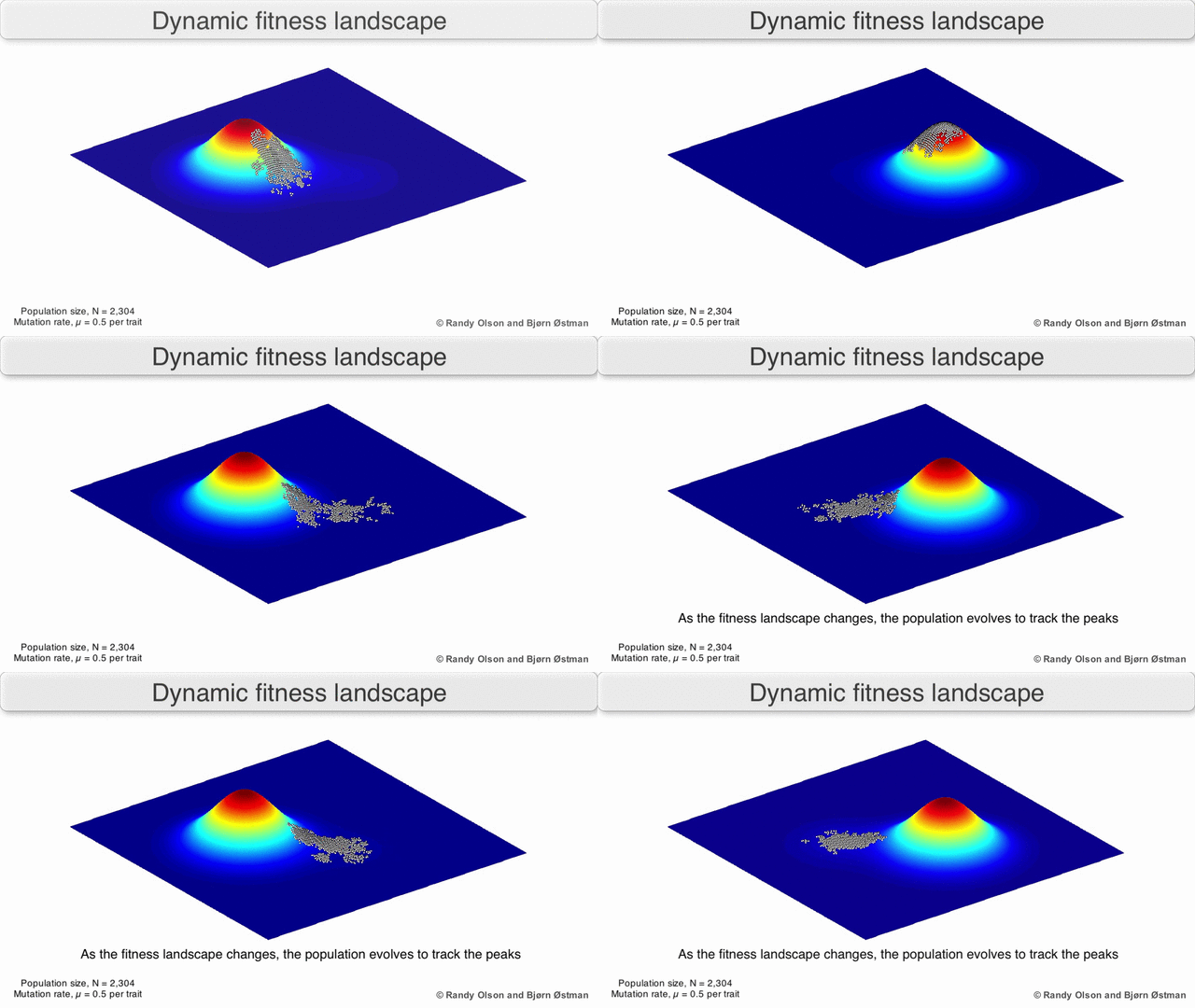
Do you really believe that if we reran the tape of life we would always end up with a continent like Australia where marsupials outnumber placental mammals?
Do you believe that every possible scenario would result in hundreds of species of dinosaurs that go extinct about 65 million years ago?
Is the great Permian extinction always going to happen?
Will an oxygen evolving complex always arise in primitive cyanobacterium about 2.5 billion years ago?
Are you convinced that replaying the tape of life will always produce eukaryotes with introns and complex spliceosomes?
Will no replay ever produce highly intelligent New World Monkeys?
Are poisonous mushrooms absolutely necessary?
Will the platypus always evolve and never go extinct?
If we ever find another planet that's very similar to Earth do you expect to find intelligent mammals and maple trees?And Larry made his own prediction:
Gould will be remembered for his attack on adaptationism and reminding us that there's more to evolution than natural selection. He will be remembered for teaching us about contingency and exaptation. He will be remembered for hierarchical theory. Above all, he will be remembered for making us all aware of the fact that evolution is a lot more complicated than we think.One objection to the tape metaphor is that it is not well-defined. Does "rewinding the tape of life" mean that everything starts out the same? The initial conditions are *exactly* the same? What about the random events that influence evolution, will they be exactly the same or are they different? Are we talking about the environmental effects (weather, plate tectonics, ET events) being the same or not? Would mutations be identical or just drawn from the same distribution? Some people may have a clear idea of these things and thus feel confident of what the metaphor really means, but I know for a fact that there is not a general consensus about this, with several evolutionary biologists that I have talked to having differing views about its interpretation. We can all agree that randomness is very important in evolution, but not what kind of randomness is part of the metaphor.


It has been demonstrated that there is a 70% correlation between the results of this test and educational achievement. Consequently, the higher your result in this test the greater your chances of success at higher levels of study. By comparison, the correlation factors in other IQ tests have an average variation of between 20 and 60%.70% is a very strong correlation, and they are probably right to point out that the strong correlation between IQ and level of education is not spurious. And yet, I think they got causality the wrong way around.


Richard and Tatu argues that differences in national income are correlated with differences in the average national intelligence quotient (IQ). They further argue that differences in average national IQs constitute one important factor, but not the only one, contributing to differences in national wealth and rates of economic growth.I ask again: do differences in average national IQ scores contribute to national wealth and economic growth, or is is more likely that national wealth contribute to raising the national average IQ? I'd say the latter, contrary to Richard and Tatu.
These results are controversial and have caused much debate, they must be interpreted with extreme caution.
Sources: IQ and the Wealth of Nations (2006), IQ and Global Inequality (2002)
 |
| http://www.gallup.com/poll/170822/believe-creationist-view-human-origins.aspx |
How long does it take to lose a culture, from a Christian perspective?Nice one, Ken! Quoting Hitler right in the beginning.
Actually, it takes only one generation.
The devil knows this, and of course God warns us about it. Adolf Hitler understood this when he said, “He alone, who owns the youth, gains the future!”
I think one of the saddest pages in the Bible is in Judges 2:10–12, “When all that generation had been gathered to their fathers, another generation arose after them who did not know the Lord nor the work which He had done for Israel. Then the children of Israel . . . forsook the Lord God of their fathers, who had brought them out of the land of Egypt; and they followed other gods from among the gods of the people who were all around them.”Really?! That's one of the saddest passages in the Bible? How about the flood, when most humans and animals perished? What about when the LORD sent two bears to maul 42 kids?
24 He turned around, looked at them and called down a curse on them in the name of the Lord. Then two bears came out of the woods and mauled forty-two of the boys.2 Kings 2:24
Obviously the parents in Joshua’s day did not teach their children as they should have—and in one generation, the devil had those kids! While it’s ultimately a matter of God’s grace that anyone is saved, God has given parents an immense responsibility to do their part. Over and over again, the Jewish fathers were told about their crucial role but they shirked it (see Psalm 78).Here is the eternal dichotomy that is such a huge problem for Christianity, but which is always ignored: if God is omnipotent, why does he need our help? Why doesn't he just make it so? If he gives us free will, how can he know everything? And why did he need to torture his own son in order to forgive us for our sins? Why doesn't he just forgive us like normal people forgive each other without the barbary?
The public schools have been teaching their own brand of apologetics: how to defend the idea of evolution and history over millions of years, thus causing multitudes of U.S. students from Christian homes to doubt the history in Genesis. Doubts about Genesis place young people on a slippery slide of unbelief that eventually destroys their confidence in the rest of Scripture. Their trust in the soul-saving gospel itself, which is grounded on the Bible’s historical claims, is undermined.Completely true. I think that is exactly how it works. Education and information is what will erode creationist beliefs, because while religion does not imply creationism, creationism does imply religion. Creationism come only from religion. The accomodationist view is a fallacious one, and the inevitable result is that more and more new adults will realize how problematic it is to reconcile the actual contradictions between scripture and scientific facts, as well as the contradictory ways of understanding the world around us, one being based on evidence and the other on faith (i.e., arbitrary beliefs contrary to evidence).
Yes, the atheists, like Hitler and Stalin, know that if they can capture the next generation (through the education system, media, etc.), they will have the culture.Hitler was Catholic. And yes, the culture will be shaped by the coming generations, of course. We all know this, and there is nothing nefarious about wanting to educate our children the best way possible. Science in science classes. Religion in history(?) classes. All of the religions. Go teach your sheep whatever you want in your own churches, but keep church and state separate in the public sphere. Also, tax the churches.
Teaching young people how God’s Word—rather than the atheistic worldview—makes sense of our world requires intense study, commitment, and fervent prayer on our parts. The church and parents must reevaluate their old assumptions about the way we should be teaching our kids in a hostile culture, and work together to build the next generation by following the directives from God’s Word.In other words, shield your children from the evil ways of the secular humanists. Teach your kids apologetics. I am pleased to see that Ken Ham really has no new answer to his problem. I'll give him one, though: remove the First Amendment, teach only the one true religion in public schools, shut down the internet, build a theocracy. That will really make your problem go away, because the next generations would then be ignorant of how the world actually works. Move to Saudi Arabia, Ken.
Imagine what would happen if God’s people raised up generations of kids who knew what they believed concerning the Christian faith, why they believe, and how to defend that faith against the secular attacks of the day. They could then proclaim the gospel with authority because they believed the authority upon which it stands. We would change the world!


Genetic analysis supports the hypothesis that today’s common bedbug originated in bat-caves and, having transitioned to cave-dwelling people, then developed populations with a preference for people and people’s houses.That's what I call evolution, rather than development. But she won't go that far:
The bedbug does provide a living laboratory to study speciation—which is limited to variation within a created kind—but it does not provide a laboratory to show how new, more complex forms of living things evolve as Darwin poetically and imaginatively asserted.Here's her great description of natural selection
About 90% of the bedbugs infesting homes today are resistant to pyrethroid insecticides. However, any reports of rapidly “evolving resistance” are poorly worded. Bedbugs remain bedbugs. They don’t evolve into anything. Those genetically equipped to survive the assault of pesticides have restored their populations with pesticide resistant offspring. This is an example of natural selection (and possibly other mechanisms), as pesticide-resistant individuals selectively survive to breed another day.But why is this not evolution, then?
There is nothing in this research either reminiscent or predictive of the evolution of increasingly complex “new forms” either wonderful or dreadful. Instead, what this research demonstrates is that bedbugs are still bedbugs, varying within their created kind to survive and thrive in a sin-cursed world.Hold on! She just described how the human variety has evolved resistance to pesticides, so what gives? Note that the scientific jargon is that development is how an organism changes in its lifetime, while evolution is how the population changes over the generations. Pesticide resistance is not something that an individual bedbug first doesn't have, then experiences pesticide, and the develops resistance. No, either an individual has it from birth through genetics or not, just as Mitchell so eloquently describes the process. So pesticide resistance is exactly a new feature, an increase in information about the environment = an increase in complexity, through evolution by natural selection. I can only conclude that Mitchell both understands evolution and believes that it occurs.
But as we infer from Genesis 1 and observe in biology, living things—including bedbugs—only reproduce and vary within their created kinds. Bedbug research actually affirms this scriptural truth rather than lending any support to the bacteria-to-bedbug fallacies of Darwinian evolution.So with semantic tricks this is not evolution because it is development, and because, even though she agrees that this is an example of speciation, it is only variation within a created kind. This kind is not defined here, and I have never seen a rigorous, scientific definition (though I've seen one based on the Bible), so it remains a question of semantics that this is not evolution. But I am happy that she agrees that speciation occurs. \o/
In BriefTattersall argues that human evolution has been unusually rapid in the last 7 million years, with many new hominin groups arising (and going extinct) and our lineage undergoing a lot of adaptive changes (tool use, brain size, anatomical modifications). Sharing cultural know-how is thought to have been under selection, steadily giving rise to humans. He then says this:
A new theory credits a combination of cultural advances and unpredictable climate change for the exceptionally fast rate of evolution in early humans.
Climate change repeatedly led to fragmentation of hominin populations, creating small groups in which genetic and cultural novelties were rapidly cemented, accelerating speciation.
Our own species, the anatomically distinctive Homo sapiens, was born out of such an event in Africa around 200,000 years ago.
About 100,000 years later an African isolate of our species acquired the ability to use symbols. It was almost certainly this unique symbolic cognition that made it possible to eliminate all hominin competition in little time.
But this sort of refinement, one generation at a time, would not have been fast enough to radically reshape the human line in seven million years.Why not? This is an assertion that Tattersall makes without any given justification. It may be so, but I don't think anyone can know this. 7 million years is maybe about 350,000 generations. That's an awful lot. If you start out with a brain that weighs just 40 grams and increase its size by one thousandth of a percent per generation for 350,000 generations, you would end up with a brain the size of humans (1,324 grams). I am not saying this is how it happened, as the fossil data suggest a doubling in between 1 million years ago and 200,000 years ago, for example. Just saying that small modifications can lead to big changes on long time-scales.
A little thought, however, suggests that there must have been more to it than that. One problem with this scenario is that it assumes that the pressures of natural selection—stresses to which the species were adapting—remained consistent over long periods. But in fact, Homo evolved during a period of Ice Ages, when the ice caps periodically advanced to what is now New York City and northern England in the Northern Hemisphere, and the tropical zone experienced periods of extreme aridity. Amid such environmental instabilities, no consistent directional selection pressures could have existed. [Emphasis added]Really? So because there are periodic fluctuations in climate there can't be a consistent directional selection pressure on brain size? That makes it sound like a colder climate pushes the size in one direction, a warmer climate pushes brain size in the opposite direction. That makes no sense to me. Rather, the environmental instabilities could all select for human ingenuity and intelligence no matter what direction the environmental changes were in. If his choice of words had not made him sound so dead-certain, and instead have made this new view more suggestive than so assured, I would not really have objected. I also don't know what actually happened, but asserting that "no consistent directional selection pressures could have existed" seems like overreaching. Tattersall continues with what I think is not an argument against directional selection at all:
The more we learn about these climatic oscillations, the more we realize just how unstable the ancient environments of our ancestors must have been. Cores drilled in the ice caps and in seafloor muds reveal that the swings between warmer and dramatically colder conditions became increasingly pronounced after about 1.4 million years ago. The result was that in any one location, resident hominin populations would have needed to react frequently to abruptly changing conditions.

Most notably, evidence of distinctively modern symbolic cognition emerged rather suddenly and only very late indeed. The earliest overtly symbolic objects—two smoothed ocher plaques with geometric engraving—show up at Blombos Cave in South Africa about 77,000 years ago, significantly after anatomically recognizable H. sapiens had entered the scene (some 200,000 years ago) [see box above]. Because the patterns involved are highly regular, researchers feel confident that they are not random but encode information. Such sudden breakthroughs are not the mark of steady intellectual advancement, generation by generation. [Emphasis added]What kind of encoding are we talking about? In kindergarten I doodled something much akin to this - regular parallel and crossing lines. I wasn't conveying any information. And yet this symbolic encoding is exactly what Tattersall proposes is the one thing that gave our lineage an edge over other hominins.
When the dust settled, we stood alone, the serendipitous beneficiaries of cognitive advances, cultural innovation and climate changes that allowed us to eliminate or outlast all hominin competition throughout the Old World in an astonishingly short time. Our competitive edge was almost certainly conferred by our acquisition of our unique mode of symbolic thought, which allows us to scheme and plan in unprecedented ways. Interestingly, this development seems to have occurred within the tenure of our species H. sapiens, evidently spurred by a cultural stimulus, quite plausibly the invention of language, which is the ultimate symbolic activity.It's not that I don't believe symbolic thought played a role. It's that I don't believe there is enough evidence that this is the case. Almost certainly this is pure speculation, and we cannot be even close to certain that what eliminated all hominin competition was ability to scheme and plan. Another hypothesis is that they were unable to cope with climate change.
Evidently, then, we have to look away from processes occurring within individual lineages to explain the rapid change among Ice Age hominins. Yet the same elements implicated in the gene-culture coevolution story—environmental pressures and material culture—may still have been in play. They simply operated rather differently from how the traditional portrayal suggests. To understand how these factors may have interacted to trigger evolutionary change, we must first recognize that a population needs to be small if it is to incorporate any substantial innovation, genetic or cultural. Large, dense populations simply have too much genetic inertia to be nudged consistently in any direction. Small, isolated populations, on the other hand, routinely differentiate.No. Just no. Populations do not need to be small to incorporate new genetic or cultural changes. Genetic inertia (= genetic homeostasis) is the maintenance of genetic variability within a population. But we know that even though random changes have a small effect on large populations, smaller changes in fitness can be discerned by the selective agents (the environmental causes of selection) in large populations. Genetic drift can indeed nudge a small population in one direction or other, but that direction is then random with respect to what is adaptive. Rather, in large populations trait changes that are adaptive (conferring a benefit in terms of survival and reproductive success) can actually become established in a large population. For example, the current human population is very large, and there is no problem sharing and establishing drastic cultural changes.
Seeing our amazing species as an evolutionary accident, though, contains a profound lesson. For if we were not shaped by evolution to be something specific—fitted to our environment and tailored to a purpose—then we have free will in a way that other species do not. We can indeed make choices about the ways in which we behave. And this means, of course, that we must accept responsibility for those choices.Free will, all of a sudden?! Then if we were shaped by evolution to be something specific, then we would not have free will, like other species? All other species do not have free will because they were shaped by evolution to be something specific? And because we are able to make choices, then we must take responsibility for them? How does that follow?


What Led to This Change?I guess that it favors his rhetoric to phrase these different world views as being religions (Ham will say 'atheism' here, but he should say humanism -which is not a religion as much as a word view). Devious, though, how he basically dismisses all other religions by this false dichotomy.
In essence this change reflects a shift between the world’s two opposing religions. Ultimately there are only two religions—one starts with God’s Word and the other starts with man’s word. America—and the whole Western world—once built its worldview predominantly on the Bible. Now a shift has occurred, as the West’s worldview is being built on man’s word. This change is reflected in a shift from Christianity’s absolutes to the relative morality of human opinions.
Whatever we once were we are no longer! These words really mean that America as a nation no longer builds its thinking on God’s Word, but man can determine truth for himself. America has changed religion—from Christianity to a man-centered religion. This spiritual disaster is now reflected in this nation’s economic and moral disaster.Of course, man has long been able to determine "truth" (i.e., moral values, in this case) by selecting reading the Bible, as Ham does himself. Does he call for God to smite the shellfish eaters, per chance? It really seems much more easy to explain the various Biblical laws as arbitrary human inventions (e.g., forbidden to eat leavened bread during the Feast of Unleavened Bread, Exodus 12:15 - what is the point?).
So What is the Solution?Really?! Whatever we once were? You mean, like slave-owning racists? Gullible peons? Disease-ridden and ignorant of the world? Perhaps that is what he means, as long as the word of God is taken literally. Sounds like Hell-on-Earth to me, ironically.
Whatever we once were we need to return to. The only solution for this nation (and every other nation) is to return to the authority of God’s Word as the foundation for our individual and cultural worldviews.
As Psalm 11:3 states, “If the foundations are destroyed, what can the righteous do?”


